A Reface PRO weekly pass costs $6.99. Left running quietly for a full year, that single subscription adds up to roughly $363, which is more than many complete photo editing suites charge for the same period. Remaker AI sits at the opposite extreme: its most popular credit pack costs $9.99 once, never renews, and simply stops working when the credits run out. Two face swap tools, two opposite theories about what casual creativity should cost.
The pricing gap is the loudest symptom of a deeper design split. Reface, built by Ukrainian developer NeoCortext, is a mobile app organized around a template library: pick a trending clip, drop in a selfie, share the result within a minute. Remaker AI is a browser platform organized around user uploads: bring both images, spend a credit, download the file. Both can swap a face convincingly. They disagree about nearly everything else.
This comparison runs that disagreement through five everyday jobs, a twelve month cost model, and a close reading of both data policies to answer a single question: which tool behaves more practically for the way people actually use face swaps in 2026.
Sixty second verdict
Reface fits instant entertainment: template memes, movie clip gags, and direct posting to TikTok or Instagram. The $24.99 annual plan is the only subscription tier that makes financial sense. Remaker AI fits anything involving personal media: group photos, image batches, uploaded video, and occasional use without a recurring charge. Neither fits photos of people who have not agreed to appear in them, and any weekly plan left running deserves a calendar reminder. |
The longer answer depends on which of the five jobs below comes up most often. The full reasoning, scores, and cost math follow.
Inside the Sunday Night Test
Every comparison needs a yardstick, and this one borrows its name from the moment most face swaps actually happen. The Sunday Night Test asks whether an ordinary person can sit down on a Sunday evening, produce a usable swap, share it before bedtime, and feel fine about the bill a month later.
Four checks feed the framework. First, five recurring jobs were performed on both tools and scored for fit on a five point margin. Second, the steps from first open to first exported swap were counted on each platform. Third, twelve months of realistic spending was modeled from official list prices. Fourth, the published privacy policies, app store data labels, and relevant court records were reviewed for both companies.
Evaluation covered Reface on iOS and Android across free and paid tiers, and Remaker AI in desktop and mobile browsers, during May and June 2026. Scores reflect editorial judgment against this rubric rather than laboratory measurement. Pricing was verified against official listings on June 8, 2026 and can change without notice.
How the two tools are built
Remaker AI in brief
Remaker AI lives at remaker.ai and runs entirely in the browser, which means it behaves the same on a laptop, an Android phone, or an iPhone without an install. Remaker AI review research shows that credit packs start at $5.99 for 200 credits and scale to $299 for 20,000, all as one-time purchases; no subscription tier appears anywhere on the official pricing page. A standard single-face photo swap consumes one credit, a multi-person swap consumes around four, and video swaps scale with clip length.
_1771314491.webp)
Free usage exists but comes with strings. Daily login credits are small, vanish instead of rolling over, and free jobs wait behind paid ones in the processing queue. Beyond swapping, the platform bundles batch face swap, video face swap, AI portrait generation, image upscaling, and background removal. One structural detail shapes everything else: there is no template catalogue, so every job begins with the user supplying both the source and the target media.
Reface in brief
Reface is a mobile app for iOS and Android from NeoCortext, and by most counts the most downloaded face swap app in the world, with hundreds of millions of installs reported across its product family. The experience is template first: a searchable catalogue of clips, GIFs, and memes waits inside the app, and a single selfie maps onto any of them in well under a minute.
The free tier stamps every export with a watermark, plays ads between swaps, and locks part of the catalogue. Paid access arrives through a ladder of options listed on the App Store: weekly passes from $2.49 to $6.99, a $12.99 monthly plan, a $24.99 annual plan, and several one time feature unlocks. Around the core swap, the app stacks extras such as Revoice, face animation, AI avatars, restyle filters, and hairstyle try ons.
| Stage | Reface (free tier) | Remaker AI (free tier) |
|---|---|---|
| Getting in | Install from the store, allow photo access | Open the site, sign in to claim daily credits |
| Setting up the swap | Take or pick a selfie, choose a template | Upload a source photo, upload a target photo |
| Getting the file out | Sit through an ad, export with a watermark | Wait in the free queue, download a clean file |
| Taps to first export | About six | About six |
First contact friction is close to a draw; the costs diverge only after the first export.
The divergence appears in what each platform keeps charging. Reface charges attention, through ads and upsell screens woven between actions. Remaker charges credits, visibly and per job. Which tax feels lighter depends entirely on the job at hand, which is where the test moves next.
Five jobs, two very different winners
Job one: the party meme
A birthday, a trending clip, one selfie. Reface was built for exactly this moment: the catalogue surfaces the meme, the swap lands in seconds, and the share sheet points straight at WhatsApp. Remaker AI can produce the same output only if the user first hunts down the meme image, saves it, and uploads it as a target. Advantage Reface, by a margin of three.
Job two: the group photo fix
A wedding gag or a team poster calls for swapping several faces inside one user supplied photo. Remaker AI handles this natively: its multi face mode detects each face, lets the user assign a replacement for every one, and charges roughly four credits for the lot. Reface's template pipeline is the wrong shape for the job, since the app expects faces to flow into its catalogue rather than into a guest's group shot. Advantage Remaker AI, by a margin of four, the widest gap in the test.
Job three: the template video gag
Dropping a friend's face into a famous movie scene is the move that made Reface a household name, and it remains the app's best trick. Clips are short, processing is fast, and lip movement tracks convincingly. Remaker AI approaches video from the other direction, swapping faces inside footage the user uploads, which costs noticeably more credits and patience. For the classic template gag, advantage Reface by three.
Job four: the weekly content batch
A small creator producing recurring swaps needs throughput, not novelty. Remaker AI's batch tool processes a folder of images in one pass, runs on the same laptop where the rest of the editing happens, and never demands a subscription to remove a watermark. Reface keeps the workflow on a phone and behind a recurring plan. Advantage Remaker AI by three.
Job five: the post and share moment
The final meter between a finished swap and a feed matters more than it sounds. Reface exports directly into TikTok, Instagram, and WhatsApp with one tap. Remaker AI ends at a download button, leaving the upload as a separate manual step. A modest but real advantage to Reface, by two.
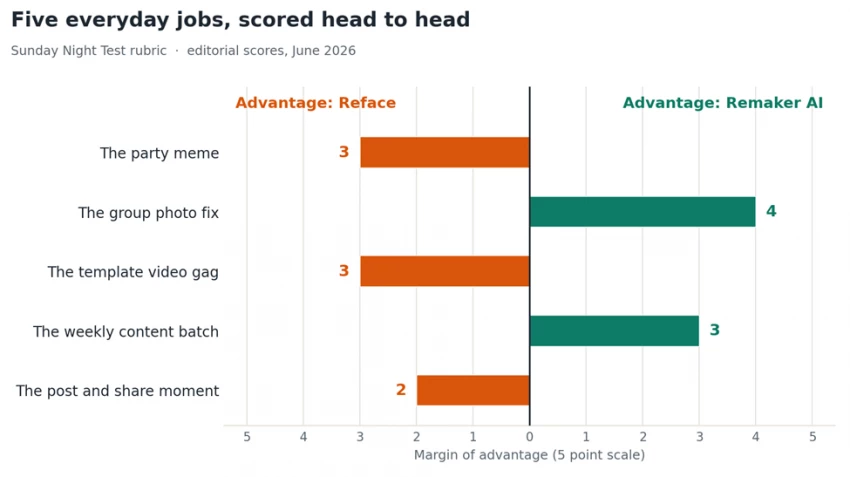
Figure 1. Reface takes three of the five jobs, Remaker AI takes two, and the combined margins land within a single point of each other.
Tallied up, the jobs round is nearly a dead heat: Reface wins on spontaneity, Remaker AI wins on anything built from the user's own media. The tiebreakers live in the next two sections, and neither is close.
What twelve months actually cost
Reface's pricing ladder rewards inattention. The weekly passes look harmless at $2.49 to $6.99, yet a pass left running becomes $129 to $363 over a year, for an entertainment app. The $24.99 annual plan is the only tier that treats the subscriber kindly, and it costs less than ten weeks of the cheapest weekly option.
The pattern around billing deserves its own paragraph. Storefront ratings for Reface run warm, while independent review platforms collect a steady stream of complaints about charges after cancellation and slow refunds. When the storefront and the outside world tell two different stories about the same app, the gap itself is information.
Remaker AI's model fails in the opposite direction. Nothing renews and nothing bills silently; a light user who buys the $9.99 pack twice a year spends about $20. The catch is the meter: video work drains credits quickly, the word free in search listings sets expectations the credit system does not honor, and a heavy month of video swapping can cost more than a Reface annual plan.
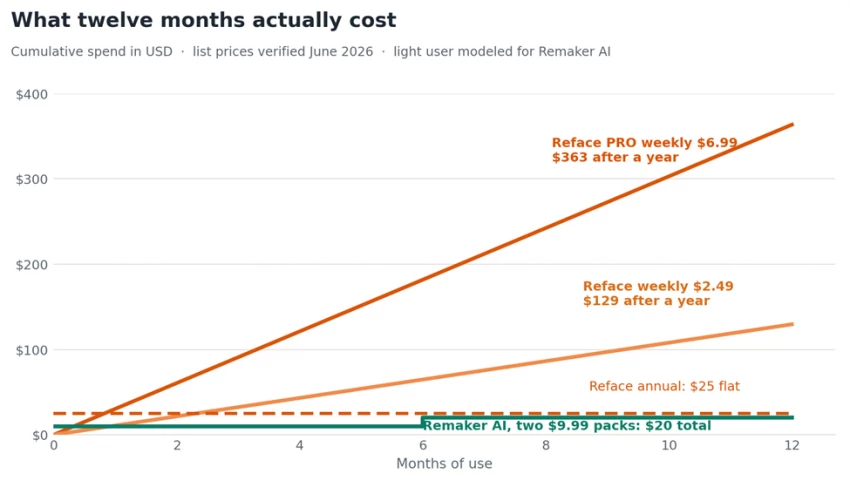
Figure 2. A forgotten weekly pass is the most expensive way to swap faces; a pair of credit packs is the cheapest.
On predictability, the verdict is one sided. Remaker AI cannot surprise anyone in month eight, because there is nothing left to charge. Reface can, and the App Store listing alone enumerates more than half a dozen ways to pay it.
Face data, deletion claims, and a courtroom
Face swap tools ask for the most personal file most people own, so the data section is not a footnote. Remaker AI's published face swap policy states that uploads and generated content are deleted within 48 hours, the strongest written commitment either company makes. The wider site policy is softer, with references to analytics partners, advertising, and the possibility of data crossing borders, so the 48 hour promise is best read as covering the media files rather than every trace of the visit.
Reface's privacy policy describes collecting uploaded photos along with facial feature data and sharing information with service providers and partners. NeoCortext also spent years defending Young v. NeoCortext, a California class action filed in 2023 by a reality television cast member who argued that the app's celebrity template catalogue used likenesses without permission; a federal judge declined to dismiss the right of publicity claim that September. The dispute targets the template model itself, which places the legal question structurally closer to Reface's core product than to Remaker's upload only design.
The wider legal climate has tightened around both. The federal TAKE IT DOWN Act now criminalizes publishing nonconsensual intimate imagery in the United States, explicitly covering AI generated likenesses, and several states layer biometric and publicity rules on top. Consent from anyone who appears in a swap has moved from courtesy to compliance.
Where each tool falls short
No verdict is honest without the bruises, and both tools collect a few.
Remaker AI: the rough edges Navigation draws the first complaint: the face swap tool is easy to land on from a search result and oddly hard to find again from inside the platform. Free tier patience runs short, since daily credits expire overnight and free jobs sit behind paid ones in the queue. Support infrastructure feels thin for a paid product, video swaps consume credits faster than most buyers expect, and swaps onto faces lit very differently from the source can look pasted rather than blended. |
Reface: the rough edges The subscription ladder is designed for inattention, with weekly passes that quietly outspend the annual plan within ten weeks. Free usage means watermarks and an ad after nearly every action. Billing disputes recur on independent review platforms, longer clips drift in quality compared with the polished short templates, and the template catalogue itself carries the likeness questions now being tested in court. User supplied media is a second class citizen throughout the app. |
Scorecard
Six categories, equal weight, scored out of ten under the Sunday Night Test rubric.
| Category | Remaker AI | Reface | Edge |
|---|---|---|---|
| Setup speed | 7.0 | 9.0 | Reface |
| Output quality | 8.0 | 7.5 | Remaker AI |
| Pricing fairness | 7.5 | 5.5 | Remaker AI |
| Feature depth | 8.0 | 8.0 | Even |
| Data handling | 6.5 | 5.0 | Remaker AI |
| Twelve month value | 8.0 | 6.0 | Remaker AI |
| Overall | 7.5 | 6.8 | Remaker AI |
Scores reflect the rubric described in the methodology section, not laboratory benchmarks.
Verdict
practical has a winner, fun has another
Strip the question to its plainest form and Remaker AI is the more practical tool. Practical means paying once instead of unsubscribing later, working in whatever browser is already open, keeping control of the source media, and stopping without a cancellation flow. Across cost predictability, data commitments, and every job built on personal photos, the credit model simply produces fewer regrets.
Reface keeps a different crown. Nothing else turns a selfie into a shareable movie scene faster, and for pure spontaneous entertainment it remains the better toy, provided the buyer treats it as a $24.99 annual purchase or skips the subscription entirely. The weekly tiers convert delight into the most expensive face swapping money can quietly buy.
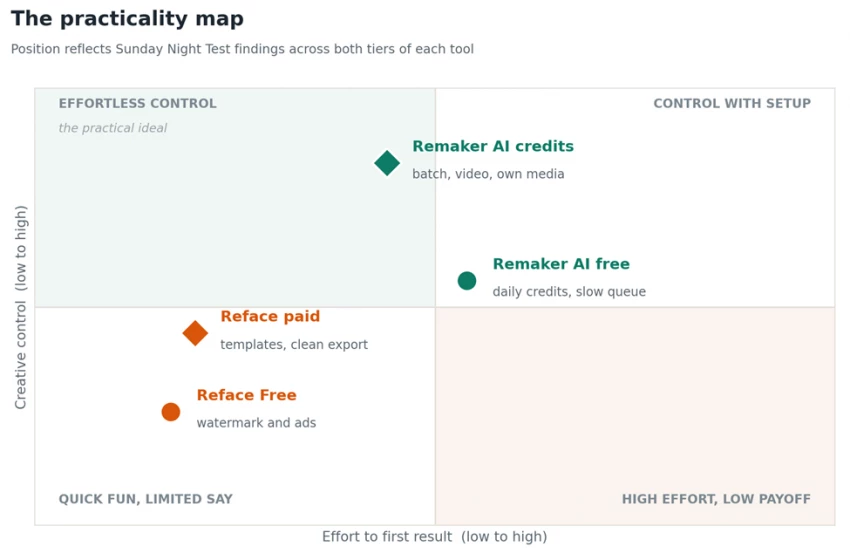
Figure 3. Paid Remaker AI sits nearest the practical ideal; Reface trades control for effortlessness.
One habit beats every feature on either platform, and it costs nothing: asking the person in the photo before their face goes anywhere. The most practical face swap is still the one nobody has to apologize for.
Post Comments
Be the first to post comment!
Related Articles



Grubby AI vs WriteHuman: Which One Should You Use?
Ridge Harper . Jun 30, 2026