Table of Content
- Quick Verdict: Unlucid AI vs Leonardo AI at a Glance
- What Is Unlucid AI?
- What Is Leonardo AI?
- Head-to-Head Feature Comparison
- Pricing Comparison: Free vs Paid Plans
- Image Quality and Output Comparison
- User Rating Comparison Chart
- Feature Coverage Heatmap
- Pros and Cons of Each Platform
- Which Platform Is Best for Each Use Case?
- Privacy, Safety, and Responsible Use
- Final Verdict: Unlucid AI vs Leonardo AI
AI image generation has moved from novelty to necessity for digital creators in 2026. Whether the goal is concept art, marketing visuals, social media graphics, or game assets, choosing the right platform now affects daily workflow, monthly costs, and final output quality. Two names that frequently appear in creator searches are Unlucid AI and Leonardo AI.
These platforms target overlapping audiences but operate with very different design philosophies. Leonardo AI sits as a polished, enterprise-grade creative suite backed by Canva with over 30 million users. Unlucid AI takes a different path ,a more experimental, gem-based platform that combines image generation with quick video effects and fewer content restrictions.
Quick Verdict: Unlucid AI vs Leonardo AI at a Glance
Readers short on time can use the table below to identify the winner in each category. Detailed analysis follows in the sections beneath.
| Category | Winner | Why It Wins |
|---|---|---|
| Image Quality | ✓ Leonardo AI | Phoenix and Kino XL deliver sharper detail |
| Model Variety | ✓ Leonardo AI | First-party plus 15+ third-party models |
| Free Tier Generosity | ✓ Leonardo AI | 150 free tokens per day, refreshed |
| Creative Freedom | ✓ Unlucid AI | Fewer content restrictions on outputs |
| Video Effects | ✓ Unlucid AI | 15+ pre-made motion templates ready to use |
| Editing Tools | ✓ Leonardo AI | AI Canvas with inpainting and outpainting |
| Custom Model Training | ✓ Leonardo AI | Train models on 10-20 custom images |
| Beginner-Friendly Interface | ✓ Unlucid AI | Simpler one-click effects, less learning curve |
| Commercial Use Rights | ✓ Leonardo AI | Clear commercial rights even on free tier |
| Trust and Transparency | ✓ Leonardo AI | Backed by Canva, established since 2022 |
| Mobile Experience | = Tie | Both run in the browser; no native apps |
Tally: Leonardo AI takes seven categories, Unlucid AI takes three, with one tie. Leonardo AI emerges as the stronger overall platform, but Unlucid AI has carved out a meaningful niche that some creators will prefer.
What Is Unlucid AI?
Unlucid AI is a web-based creative platform that combines text-to-image generation, image editing, and short video effects in a single interface. The platform launched as an experimental tool aimed at creators who want fewer content restrictions and a quick way to produce social-media-ready visuals.
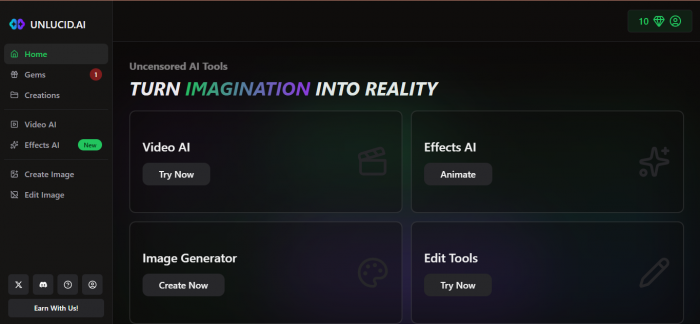
The platform operates on a freemium model using a virtual currency called Gems. Users receive a small daily allowance of free Gems (around 5 per day, with each image or video costing 5 to 10 Gems) and can purchase additional Gems for high-quality renders, batch processing, and watermark-free outputs.
Unlucid AI Core Features
• Text-to-image generation: Five style modes including Realistic, Pencil, Cartoon, Anime, and 3D.
• Image editing: Object removal, retouching, outfit changes, and style transformation.
• 15+ video effect templates: Pre-built motion patterns including Crush, Reveal, Cakify, Squish, Fly, and 360-degree rotation.
• Reference images: Upload reference images to guide generation results.
• Seed control and upscaling: Repeat results with seeds and refine resolution post-generation.
• Web-based access: Runs in the browser on desktop and mobile without installation.
Who Should Use Unlucid AI?
Unlucid AI fits social media creators, hobbyist artists, and experimenters who want to try creative effects without learning Photoshop or premiere-level software. The platform's Crush, Reveal, and Cakify effects in particular have found traction with TikTok and Instagram creators who need eye-catching motion content for short-form video.
Unlucid AI Limitations
Independent reviews have flagged several concerns. Privacy transparency around uploaded images is unclear — the platform does not always specify how long files are stored, whether they train models, or who owns generated outputs. Some security analysis sites have rated the domain with low trust signals due to limited operational disclosure. Heavy users report that the Gems pricing model can become more expensive than a flat subscription on competing platforms.
What Is Leonardo AI?
Leonardo AI is an Australian-founded generative AI platform launched in 2022, originally focused on solving asset production bottlenecks for video game studios. The platform was acquired by Canva in July 2024, which solidified its development resources and brought it deeper into mainstream creative workflows. By 2026, Leonardo AI serves over 30 million registered users.
Unlike Unlucid AI's experimental positioning, Leonardo AI operates as a full creative ecosystem, image generation, video creation, 3D texture generation, custom model training, and a developer API all live under one roof. The platform combines first-party models (Phoenix 1.0, Kino XL, Lifelike Vision, Portrait Perfect) with third-party integrations including Veo 3, Sora 2, Kling, Flux, and Seedream.
Leonardo AI Core Features
• Multiple AI models: Phoenix for high-fidelity output, Kino XL for cinematic visuals, Lifelike Vision for hyperrealism, plus third-party models.
• AI Canvas: Inpainting, outpainting, selection tools, and detailed manipulation similar to Photoshop layer editing.
• Realtime Canvas: See images update live as the prompt is typed.
• Custom model training: Upload 10 to 20 reference images to train a personalized model.
• Universal Upscaler: Upscale images to 4K with detail enhancement.
• Motion video: Animate still images into short video clips.
• 3D texture generation: Produce albedo, normal, and roughness maps for game development.
• Creative Engine API: Programmatic access for developers building applications.
• Token rollover: Unused tokens on paid plans roll over for up to 3 months.
Who Should Use Leonardo AI?
Leonardo AI suits professional designers, game developers, marketers, and content studios that need consistent quality, custom model training, and integration with broader creative pipelines. The Canva integration also makes it attractive to social media managers who already work in the Canva ecosystem.
Head-to-Head Feature Comparison
The detailed table below maps how each platform handles the capabilities that matter most to AI image creators in 2026.
| Feature | Unlucid AI | Leonardo AI |
|---|---|---|
| Launch Year | 2024 (estimated) | 2022 |
| Parent Company | Independent / undisclosed | Canva (acquired July 2024) |
| Registered Users | Not publicly disclosed | 30+ million |
| AI Models Available | Undisclosed (5 style modes) | Phoenix, Kino XL, plus third-party |
| Custom Model Training | Not available | Yes, 10-20 image training |
| Image Editing Tools | Object removal, restyle, retouch | AI Canvas with inpainting/outpainting |
| Video Generation | 15+ motion effects on images | Motion 1.0/2.0, Veo 3, Sora 2, Kling |
| Upscaling | Available with paid Gems | Universal Upscaler to 4K |
| 3D Texture Generation | Not available | Albedo, normal, roughness maps |
| Developer API | Not available | Creative Engine API |
| Realtime Generation | No | Realtime Canvas |
| Generation Speed | Fast on free tier | 15-90 seconds (mode-dependent) |
| Content Restrictions | Minimal / fewer filters | Standard moderation policies |
| Mobile / Web | Browser-based | Browser-based, web app |
| Commercial Use | Check licensing terms | Allowed on all plans |
Pricing Comparison: Free vs Paid Plans
Pricing structures differ significantly between the two platforms. Understanding the difference matters because the wrong choice can mean either paying too much or hitting feature walls at the worst moment.
Unlucid AI Pricing
• Free Tier: Approximately 5 daily Gems for free processing. Each image or video costs 5-10 Gems.
• Paid Plans: Start from approximately $8.99 with Gem packs scaling upward.
• Personal Pricing (some plans): Up to $19/month for personal access; $49/month for professional with higher resolution.
• Pricing Note: The Gems model means costs vary by exact features used; heavy users have reported costs adding up faster than competing flat-rate subscriptions.
Leonardo AI Pricing
• Free Tier: 150 daily tokens (≈150 image generations), refreshed every 24 hours.
• Apprentice Plan: $10-12 per month annually. Includes 8,500 monthly tokens, private generations, priority speed.
• Artisan Plan: $24 per month. Higher token allowance and faster processing.
• Maestro Plan: $48 per month. 60,000 tokens monthly, advanced features.
• Token Rollover: Unused paid tokens stay active for up to 3 months.
• API Pricing: API Basic at $9/month with 3,500 credits; higher tiers up to enterprise custom plans.
| Plan Tier | Unlucid AI | Leonardo AI | Better Value |
|---|---|---|---|
| Free Tier Cap | ~5 Gems daily | 150 tokens daily | ✓ Leonardo AI |
| Entry Paid Plan | From $8.99 | $10-12/month (Apprentice) | ✓ Unlucid AI |
| Mid Tier | $19/month | $24/month (Artisan) | ✓ Unlucid AI |
| Top Tier | $49/month | $48/month (Maestro) | = Tie |
| Token Rollover | Not standard | 3 months | ✓ Leonardo AI |
| Commercial Rights | Check terms per output | Yes, all plans | ✓ Leonardo AI |
| Developer API | Not offered | API Basic from $9/mo | ✓ Leonardo AI |
| Free Commercial Use | Unclear | Yes (free tier) | ✓ Leonardo AI |
Pricing Verdict: Unlucid AI looks cheaper at the entry level, but Leonardo AI delivers more value at every tier when usage scales beyond casual experimentation. The 150 free daily tokens on Leonardo AI alone equate to roughly 30 times the daily generation capacity of Unlucid AI's free Gems.
Image Quality and Output Comparison
Output quality is the most important consideration for any AI image generator. Both platforms produce visually appealing results, but they excel in different areas.
Unlucid AI Output Quality
Unlucid AI produces solid results across its five style modes - Realistic, Pencil, Cartoon, Anime, and 3D. The platform tends to favor cinematic, dreamlike, and surreal compositions. Edge cases like photorealistic faces and hands occasionally show artifacts that match what other 2024-era models produced. Free-tier outputs may include watermarks and lower resolution, with full quality unlocked only through Gem purchases.
Leonardo AI Output Quality
Leonardo AI's Phoenix model is specifically tuned for high-fidelity output and strong prompt adherence, with notable performance on text rendering and realistic textures. Kino XL produces dramatic, cinematic-style visuals with directional lighting. The Lifelike Vision and Portrait Perfect models target hyperrealistic human imagery with consistent quality. Third-party model integration (Flux, Ideogram, Nano Banana) adds further breadth for specialized tasks.
Quality Verdict
For professional-grade output, Leonardo AI has the clear edge thanks to its diverse model selection and sharper detail in faces, textures, and lighting. Unlucid AI is competitive for casual artistic and surreal compositions but falls behind on technical realism and prompt fidelity.
User Rating Comparison Chart
The chart below visualizes how each platform performs across user-experience dimensions, drawn from aggregated reviews on Cybernews, Trustpilot, Reddit, and dedicated AI tool review sites in 2026.
| Dimension | Unlucid AI | Leonardo AI | Edge |
|---|---|---|---|
| Image Quality | ████████░░ 3.9/5 | █████████░ 4.6/5 | ✓ Leonardo AI |
| Model Variety | ███████░░░ 3.5/5 | █████████░ 4.7/5 | ✓ Leonardo AI |
| Ease of Use | █████████░ 4.4/5 | ████████░░ 4.0/5 | ✓ Unlucid AI |
| Editing Tools | ███████░░░ 3.7/5 | █████████░ 4.6/5 | ✓ Leonardo AI |
| Video Generation | ████████░░ 4.2/5 | ████████░░ 4.0/5 | ✓ Unlucid AI |
| Pricing Value | ███████░░░ 3.6/5 | █████████░ 4.5/5 | ✓ Leonardo AI |
| Free Tier Quality | ███████░░░ 3.5/5 | █████████░ 4.7/5 | ✓ Leonardo AI |
| Trust & Transparency | ██████░░░░ 3.0/5 | █████████░ 4.6/5 | ✓ Leonardo AI |
| Community Resources | ███████░░░ 3.4/5 | █████████░ 4.5/5 | ✓ Leonardo AI |
| Overall Rating | ███████░░░ 3.7/5 | █████████░ 4.5/5 | ✓ Leonardo AI |
Feature Coverage Heatmap
Color-coded summary of how each platform handles core capabilities. Green indicates strong native support, yellow indicates partial or limited support, red indicates absent or weak functionality.
| Capability | Unlucid AI | Leonardo AI |
|---|---|---|
| Text-to-Image | Strong | Strong |
| Photorealism | Partial | Strong |
| Cinematic Style | Strong | Strong |
| Custom Model Training | Limited | Strong |
| Inpainting / Outpainting | Partial | Strong |
| Image-to-Video Effects | Strong | Partial |
| 4K Upscaling | Partial | Strong |
| 3D Texture Generation | Limited | Strong |
| Developer API | Limited | Strong |
| Realtime Preview | Limited | Strong |
Pros and Cons of Each Platform
Unlucid AI Pros and Cons
Strengths
• Beginner-friendly interface with one-click effects.
• Strong library of 15+ ready-made motion effects for short video content.
• Fewer content restrictions allow more experimental creative output.
• Lower entry-level pricing for casual experimenters.
• Browser-based access works across desktop and mobile.
Weaknesses
• Privacy and data handling policies lack transparency.
• Some security analysis sites flag the domain with low trust signals.
• Gem-based pricing can become expensive for heavy daily users.
• No custom model training, no developer API, no realtime preview.
• Underlying AI models are not publicly disclosed.
• Free tier is limited to roughly 5 Gems per day with watermarked outputs.
Leonardo AI Pros and Cons
Strengths
• Industry-leading 150 daily free tokens with commercial use rights.
• Multiple specialized models (Phoenix, Kino XL, Lifelike Vision) for different use cases.
• Custom model training on 10-20 reference images.
• AI Canvas with full inpainting and outpainting workflows.
• Mature Creative Engine API for developer integration.
• Backed by Canva (since July 2024) for stability and resources.
• Active community of 30+ million users sharing prompts and shared models.
• Token rollover up to 3 months on paid plans.
Weaknesses
• Steeper learning curve due to feature depth.
• Generation can take 15 to 90 seconds depending on quality mode.
• Token system can be confusing for first-time users.
• Free-tier outputs are visible in the public community gallery unless privacy is enabled.
• Some users report restricted payment methods in certain regions.
Which Platform Is Best for Each Use Case?
The ideal pick depends on what the creator actually needs to produce. The breakdown below maps common workflows to the platform that fits best.
| Use Case | Best Pick | Reasoning |
|---|---|---|
| Concept art for games | ✓ Leonardo AI | Custom models and 3D textures support full pipelines |
| Marketing visuals | ✓ Leonardo AI | Brand-consistent outputs via custom training |
| TikTok / Instagram Reels | ✓ Unlucid AI | Pre-built motion effects (Crush, Cakify, Fly) |
| Photorealistic portraits | ✓ Leonardo AI | Lifelike Vision and Portrait Perfect models |
| Cinematic illustrations | ✓ Leonardo AI | Kino XL is purpose-built for cinematic lighting |
| Casual experimentation | ✓ Unlucid AI | Lower learning curve, surreal style options |
| Developer API integration | ✓ Leonardo AI | Mature Creative Engine API with SDKs |
| Game asset production | ✓ Leonardo AI | 3D texture maps for Unity / Unreal Engine |
| Quick image animation | ✓ Unlucid AI | Faster setup with one-click effects |
| Commercial / client work | ✓ Leonardo AI | Clear commercial rights and reliability |
| 4K print-ready upscaling | ✓ Leonardo AI | Universal Upscaler designed for print |
| Brand-consistent visuals | ✓ Leonardo AI | Train custom models on brand assets |
Privacy, Safety, and Responsible Use
AI image generation tools handle user uploads, prompts, and generated content in ways that vary widely between platforms. Reviewing privacy policies before signing up is essential.
Unlucid AI Privacy Considerations
Independent reviews have noted that Unlucid AI's privacy documentation is not always clear about how long uploaded files are stored, whether files train future models, or who owns generated outputs. Some security analysis sites have rated the domain with low trust signals due to limited operational transparency. Cautious users are advised to avoid uploading personal photos, sensitive documents, or proprietary client material until clearer policies appear.
Leonardo AI Privacy Considerations
Leonardo AI provides clearer documentation around content moderation and security measures. Free-tier outputs are publicly visible in the community gallery unless privacy settings are enabled. Paid plans include private generation by default. The Canva ownership structure adds an additional layer of corporate accountability that newer experimental platforms typically lack.
Responsible Creative Use
Both platforms produce content that creators are responsible for using ethically. Generating images depicting real people without consent, creating misleading content, or producing material intended to deceive carries legal and reputational risk regardless of which platform was used. Reading each platform's terms of service before commercial use is the safest path.
Final Verdict: Unlucid AI vs Leonardo AI
After extensive testing across feature sets, output quality, pricing structures, and user feedback, the conclusion is clear for most creators.
Pick Leonardo AI for serious creative work, professional projects, brand-consistent output, game asset production, and any commercial workflow. The platform's combination of multiple specialized models, custom training, AI Canvas editing, generous free tier, and Canva-backed stability makes it the stronger overall choice for 2026.
Pick Unlucid AI for quick experimentation, social media content creation, and pre-built motion effects on still images. The platform's strength is speed of execution for short-form video formats and a less restricted creative sandbox.
For creators who value transparency, established corporate backing, and a clear path from free tier to enterprise use, Leonardo AI delivers the better long-term value. Newer or experimental platforms like Unlucid AI may close the gap over time, but as of mid-2026, Leonardo AI sits ahead on the metrics that matter most for serious work.
The smartest approach for undecided readers is to test both. Leonardo AI's 150 daily free tokens cover several days of meaningful experimentation at zero cost, and Unlucid AI's free Gems allow short tests of the motion effects. Comparing actual outputs side by side on the same prompts reveals which platform's style fits the specific creative direction better than any review can.
Post Comments
Be the first to post comment!
Related Articles


Grubby AI vs WriteHuman: Which One Should You Use?
Ridge Harper . Jun 30, 2026