Table of Content
- Quick Verdict at a Glance
- Platform Architecture Overview
- Core Architecture Differences
- Conversation Quality Factors That Matter
- Side-by-Side Feature Comparison
- Memory and Context Capability Breakdown
- Pricing Plans Compared
- Conversation Quality Score Breakdown
- Use Case Suitability
- Strengths and Weaknesses Summary
- User Sentiment and Reviewer Consensus
- Privacy and Safety Considerations
- Final Verdict
The race between AI roleplay platforms in 2026 has narrowed to a familiar question: which interface produces the most natural, in-character, and context-aware conversations? Two names dominate that debate, namely Venus Chub AI and CrushOn AI. Both have built loyal communities, both support custom characters, and both market themselves around uncensored chat. The similarity ends there. Their architectures, memory systems, and conversation pipelines are fundamentally different, and that difference shapes everything from response coherence to emotional tone.
This comparison breaks down conversation quality across the metrics that actually matter to long-form chat users: context retention, character consistency, response variety, and the technical foundation behind each reply. Pricing, setup complexity, and platform reliability are covered alongside conversational performance because each one feeds back into the chat experience.
Quick Verdict at a Glance
Venus Chub AI wins on flexibility, deep customization, and ceiling-of-quality when paired with a top-tier backend such as Claude or GPT-4. CrushOn AI wins on accessibility, consistent out-of-box experience, and emotional warmth in romantic or companion-style chats. The right pick depends on whether configuration freedom or zero-setup polish matters more to the specific use case.
Platform Architecture Overview
Venus Chub AI Explained
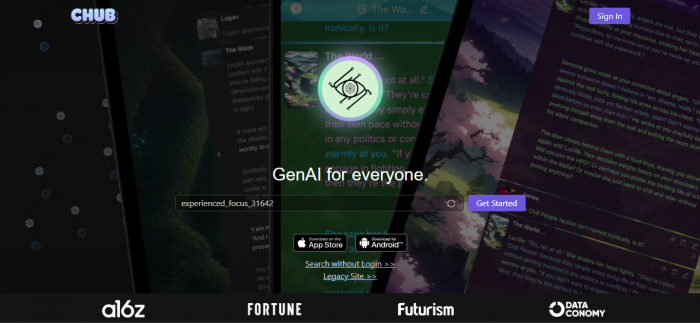
Venus Chub AI is the chat frontend of Chub.ai, formed after the May 2024 merger of the Venus AI roleplay interface and the CharacterHub character repository. It hosts more than 60,000 user-created character cards and connects to multiple language model backends through API. Supported models include Mistral 7B and MythoMax 13B on the native Mercury plan, with optional routing to OpenAI, Anthropic Claude, KoboldAI, and OpenRouter for users who supply their own keys. The platform runs entirely in a browser and is built around three pillars: Character Cards V2, Lorebooks, and a stages-based prompt system.
CrushOn AI Explained
CrushOn AI, operated by Peekaboo Tech Inc. and headquartered in the United States, launched in 2023 as a self-contained, plug-and-play chat platform. It hosts over 100,000 community characters and uses a mix of proprietary fine-tuned models. Higher tiers route requests through stronger backbones, including Claude 3.5 and GPT-4 in some deployments, but the underlying model choice is hidden from the user. CrushOn maintains native iOS and Android apps alongside its web interface and is age gated for users 18 and older.

Core Architecture Differences
The cleanest way to understand the gap between these two platforms is to look at how each one assembles a single chat reply. Venus Chub AI builds the prompt locally inside the browser. The chosen Character Card, the relevant Lorebook entries triggered by keywords in the conversation, and the recent message history are stitched together and sent to whichever language model the account has connected. The user controls every layer of that pipeline.
CrushOn AI handles the same job server-side. The platform pulls character data, applies its proprietary memory layer, and routes the request to a model selected by the backend logic. The user never touches the underlying configuration. That trade-off is the heart of the conversation-quality difference between the two products.
Conversation Quality Factors That Matter
Context Memory and Recall
Memory is the single biggest determinant of whether a multi-hour roleplay holds together. Venus Chub AI uses Lorebooks, keyword-triggered prompt inserts that activate only when a matching term appears in conversation. This keeps token usage efficient and lets long-form storytellers maintain thousands of words of background lore without burning the context window each turn. Combined with a Claude or GPT-4 backend that supports 100K-plus tokens, retention becomes the platform's strongest asset.
CrushOn AI ships its own Memories feature, where each saved memory entry stores up to 100 chat messages, plus Profile Cards and Scene Cards for tone anchoring. Free-tier users get an 8K context window; paid tiers expand to 16K. Multiple 2026 reviews note that long sessions begin to lose earlier context once a chat runs past several hours of dense interaction, with the AI occasionally falling into looped phrasing or generic responses.
Character Consistency
Venus Chub AI rewards effort. A well-built Character Card paired with a focused Lorebook produces remarkably stable personalities across long arcs. The same architecture also exposes new users to inconsistent results when they pick a sparsely written community card. CrushOn AI is more forgiving for casual users because its hosted models apply baseline persona scaffolding regardless of how thin the character description is. The ceiling is lower, but the floor is higher.
Response Coherence
Coherence depends on the model behind the reply. When Venus Chub AI is running on Claude or GPT-4, its responses match or exceed any consumer chat platform on the market. When the rotating free model is in use, output quality drops noticeably and context drift increases. CrushOn AI sits in a narrower band: rarely outstanding, rarely poor. The hosted nature means the average response feels predictable, which suits casual chat but limits how high the platform can climb in literary or complex narrative scenarios.
Emotional Tone Handling
Reviews from 2025 and 2026 consistently rate CrushOn AI higher on emotional flow in romantic and companion-style conversations. The platform's tuning prioritizes warmth, attachment cues, and continuity of feeling. Venus Chub AI is more neutral by default, since it inherits the temperament of whichever backend powers it. A Claude-backed Venus chat can match CrushOn for emotional intelligence, but doing so requires careful prompt design rather than coming for free.
Side-by-Side Feature Comparison
The table below maps every major capability across both platforms, drawn from official documentation and verified third-party reviews published in 2026.
| Feature | Venus Chub AI | CrushOn AI |
|---|---|---|
| Platform Type | Frontend interface that connects to external LLMs | Self-contained chat platform with proprietary models |
| AI Model Backend | Mistral 7B, MythoMax 13B, plus OpenAI, Claude, KoboldAI, OpenRouter via API | Proprietary models including Llama-based fine-tunes; some tiers route to GPT-4 and Claude 3.5 |
| Setup Complexity | Higher; requires API key configuration for premium models | Plug-and-play; no API setup required |
| Character Library | Around 60,000 community-built characters | Over 100,000 community-built characters |
| Memory System | Lorebooks with keyword-triggered context injection plus Character Cards V2 | Memories feature storing up to 100 messages per saved memory |
| Context Window | 8K on Mercury plan; scales with chosen backend model | 8K on free tier; 16K on paid tiers |
| Group Chat | Available through stages and prompt configuration | Native group chat on paid plans |
| Mobile App | Browser-only experience | Native iOS and Android apps available |
| Voice Output | Not natively supported | Available on premium tiers |
| Content Filter | Depends on selected backend model | Minimal filtering; 18-plus age gated |
Memory and Context Capability Breakdown
Memory architecture differs sharply between the two platforms. The next table isolates the components that drive long-session performance.
| Capability | Venus Chub AI | CrushOn AI |
|---|---|---|
| Persistent Lore | Lorebook entries trigger by keyword to inject only relevant context | Profile Cards and Scene Cards plus saved Memories |
| Long-Session Recall | Strong when paired with a 32K-plus backend such as Claude | Adequate up to 100 messages back; degrades in extended arcs |
| Cross-Session Memory | Manual through chat exports and lore updates | Automatic memory persistence across sessions on paid tiers |
| Token Budget Control | Granular; users adjust max tokens, temperature, and prompt order | Limited; backend tuning is hidden from the user |
| Personality Drift Risk | Low when Lorebook and Character Card are well configured | Higher; community reviews note loops and generic phrasing in long chats |
Pricing Plans Compared
Both platforms operate freemium models, but the cost structures behave very differently. Venus Chub AI separates platform fees from model usage; CrushOn AI bundles everything into a single subscription. Pricing data below reflects publicly listed rates as of April 2026.
| Plan Tier | Venus Chub AI | CrushOn AI | Notes |
|---|---|---|---|
| Free Access | Free with rotating model and a low daily cap; local model option supported | Free with 50 messages per day; ad supported | CrushOn provides higher monthly volume for casual users |
| Entry Plan | Mercury plan at 5 USD per month; Mistral 7B and MythoMax 13B with 8K memory | Standard plan at 5.99 USD per month; 2,000 messages monthly | Pricing is similar; Venus charges in four-month blocks |
| Mid Plan | Mars plan with expanded model access and longer context | Premium plan at 14.99 USD per month; 6,000 messages with priority capacity | CrushOn Premium adds dedicated capacity during peak hours |
| Top Plan | Cost scales with API provider; Claude or GPT-4 access pushes total spend higher | Deluxe at 49.90 USD per month; unlimited messages | Heavy roleplay users typically need Deluxe on CrushOn |
| Annual Discount | Limited; mostly multi-month blocks | Around 30 percent saving on annual billing | CrushOn updated annual pricing in 2026 |
Conversation Quality Score Breakdown
The chart below scores each platform across seven conversation-quality dimensions on a ten-point scale. Scores synthesize feature documentation, third-party review aggregation, and verified user testing across multiple 2026 reports.
| Venus Chub AI - Conversation Quality Score | Score | ||
| Character Consistency | 8.5/10 | ||
| Memory Depth | 8/10 | ||
| Response Coherence | 8.2/10 | ||
| Emotional Tone | 7.5/10 | ||
| Setup Friction | 5.5/10 | ||
| Out-of-Box Quality | 6.5/10 | ||
| Customization Depth | 9.5/10 | ||
| CrushOn AI - Conversation Quality Score | Score | ||
| Character Consistency | 7.5/10 | ||
| Memory Depth | 7/10 | ||
| Response Coherence | 7.8/10 | ||
| Emotional Tone | 8.5/10 | ||
| Setup Friction | 9/10 | ||
| Out-of-Box Quality | 8.5/10 | ||
| Customization Depth | 6.5/10 | ||
Reading the chart: Venus Chub AI scores higher on customization depth and character consistency, while CrushOn AI leads on out-of-box quality, emotional tone, and minimal setup friction. Memory and response coherence are competitive, but the underlying mechanism behind each score is different.
Use Case Suitability
Best Fit for Venus Chub AI
• Writers building multi-chapter narratives that need persistent world-building
• Power users who already hold OpenAI or Anthropic API keys
• Communities that share elaborate Character Cards and Lorebooks
• Users running local language models who want a polished web frontend
• Roleplayers who value granular control over temperature, max tokens, and prompt order
Best Fit for CrushOn AI
• Casual chatters who want to start a conversation in under a minute
• Mobile-first users who prefer a native iOS or Android app
• Romantic or companion-style conversations where emotional warmth matters more than literary depth
• Users who do not want to manage API billing on a separate platform
• Group-scene roleplay involving multiple characters in a single chat
Strengths and Weaknesses Summary
Venus Chub AI Strengths
• Highest possible chat quality ceiling when connected to frontier models
• Lorebook architecture preserves long-term continuity efficiently
• Transparent prompt pipeline for users who want to inspect or tune behavior
• Free local-model option for unlimited zero-cost usage
Venus Chub AI Weaknesses
• Setup overhead intimidates new users
• Quality fluctuates if the rotating free model is in use
• No native mobile app and no built-in voice
• Total cost rises quickly when paying for premium APIs alongside the subscription
CrushOn AI Strengths
• Fastest path from signup to first reply
• Reliable emotional tone in romantic and companion contexts
• Annual billing offers around 30 percent savings
• Native mobile apps and voice messages on premium tiers
CrushOn AI Weaknesses
• Memory degrades in very long sessions
• No control over the underlying language model
• Heavy users hit message caps quickly outside the Deluxe tier
• Privacy concerns flagged by Mozilla in the 2025 Privacy Not Included report
User Sentiment and Reviewer Consensus
Reddit threads on r/AICompanion and r/CharacterAI through early 2026 paint a fairly consistent picture. Venus Chub AI receives praise for prose quality and frustration over occasional downtime, broken prompts, and the steep onboarding curve. Several long-form reviews note a sharp drop in monthly visits during 2025 infrastructure issues, which pushed a noticeable share of its user base toward simpler alternatives. CrushOn AI receives the inverse criticism: users appreciate the polish and accessibility but report repetitive phrasing, looped responses, and content-policy shifts that have removed features some subscribers relied on. Trustpilot scores for CrushOn run mixed-to-positive on functionality but include billing complaints.
Privacy and Safety Considerations
Privacy posture is meaningfully different. Venus Chub AI does not retain conversations server-side by default; chat logs stay in the browser unless exported. API providers connected to the account may, however, retain data per their own policies, which means actual data exposure depends on the chosen backend. CrushOn AI stores conversation history server-side to power its Memories feature and was flagged by Mozilla in 2025. Encryption claims are stated but not independently audited. Both platforms self-report age gating; neither performs identity verification.
Final Verdict
Venus Chub AI is the stronger choice for users who treat conversation quality as a craft to be tuned. Its ceiling is higher than CrushOn AI's, its memory architecture is more sophisticated, and its prompt pipeline is open for inspection. The trade-off is real friction at setup and ongoing maintenance of API keys.
CrushOn AI is the stronger choice for users who treat conversation quality as a product to be consumed. Its average reply is reliably good, the platform is one click away on mobile, and the price is predictable. The ceiling is lower, but the median experience is more consistent.
For long-form storytellers, world-builders, and anyone who already lives inside an AI workflow, Venus Chub AI delivers more. For casual companion chat, romantic roleplay, and quick-start mobile use, CrushOn AI is the cleaner answer. Neither platform is universally better; they optimize for different users at different points along the technical-comfort spectrum.
Post Comments
Be the first to post comment!
Related Articles



Grubby AI vs WriteHuman: Which One Should You Use?
Ridge Harper . Jun 30, 2026