Table of Content
- What Is BarberGPT AI? (Quick Overview)
- What Is Traditional Barbershop Styling?
- BarberGPT AI vs Traditional Styling: At-a-Glance Comparison
- BarberGPT AI vs Traditional Barber: 7 Key Differences
- BarberGPT AI vs Traditional Styling: Full Pricing Breakdown
- BarberGPT AI Pros and Cons
- Traditional Barbershop Pros and Cons
- BarberGPT AI vs Traditional Styling: Use Case Recommendations
- BarberGPT AI vs Traditional Barbers: Real User Reviews
- Final Verdict: BarberGPT AI vs Traditional Styling Which Wins?
BARBERGPT AI VS TRADITIONAL STYLING: THE QUICK ANSWER
| BarberGPT AI and a traditional barber are not competing products they solve different problems. BarberGPT AI is a hairstyle preview tool that costs $0.05–$0.30 per generation and helps you decide what to ask for. A traditional barber executes the haircut and costs $25–$65 on average in the US (Yelp data). Use BarberGPT before your appointment to test 10 styles in 5 minutes; use a real barber to actually cut your hair. They work better together than apart. |
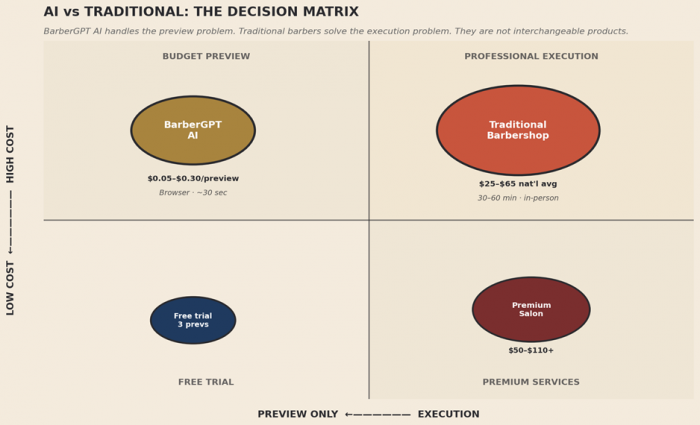
Figure 1: Decision matrix showing where BarberGPT AI and traditional barbershops sit relative to cost and execution. The two are complements, not substitutes. Source: editorial testing, March–April 2026; pricing data from Yelp, Booksy, BarberGPT.ai.
What Is BarberGPT AI? (Quick Overview)
BarberGPT AI is a browser-based hairstyle preview tool that uses generative AI to show what different haircuts would look like on your face. Users upload a clear front-facing photo, manually mask the hair area with a brush tool, and the AI generates realistic previews in approximately 30–60 seconds per style.
The tool runs entirely in a web browser with no app to download and no account required for the free trial. BarberGPT focuses primarily on men's hairstyles, including buzz cuts, fades, short curls, dreadlocks, man buns, and longer textured styles. Women's and children's styles have been announced as upcoming features but are not yet available as of April 2026.
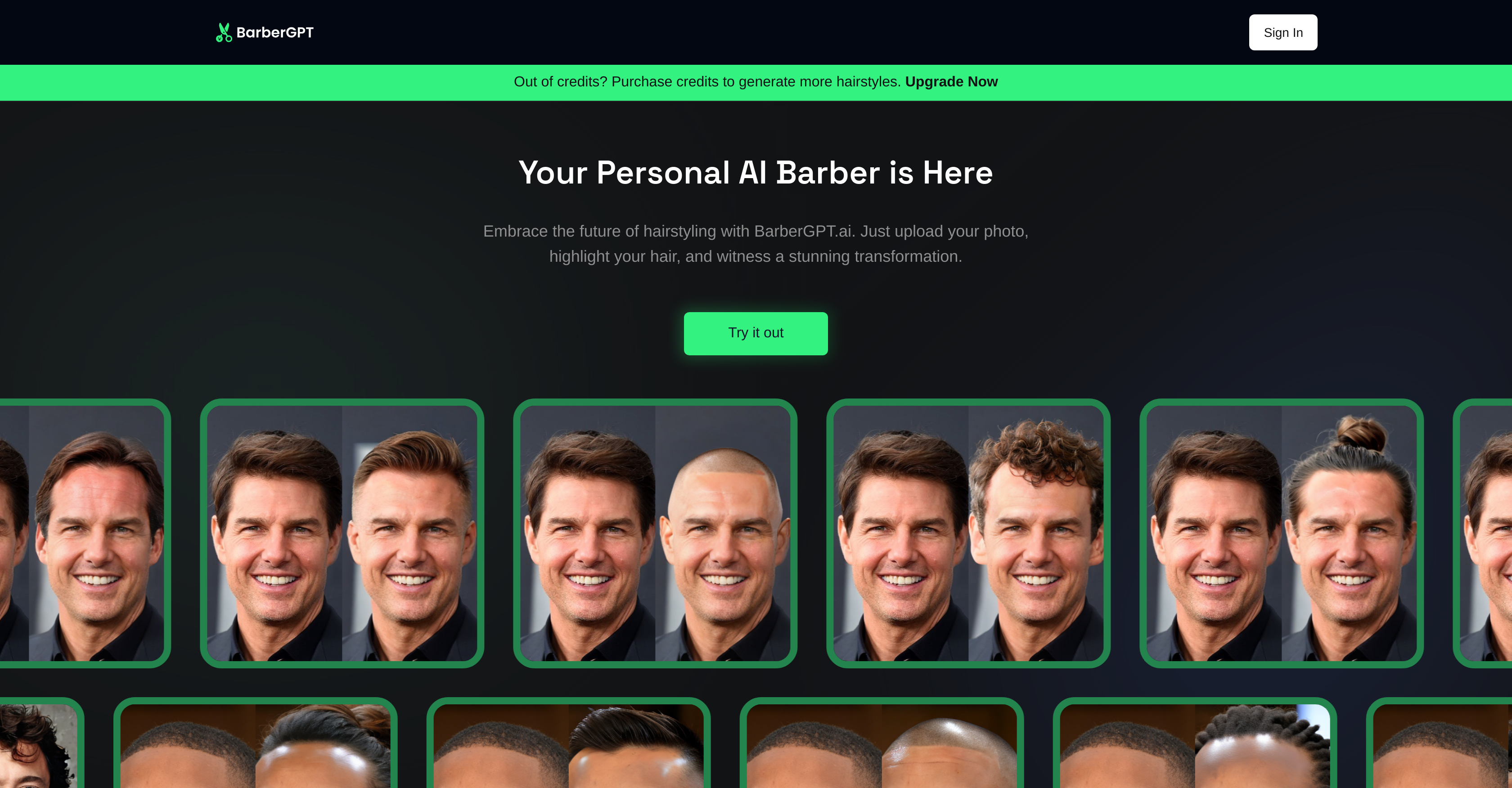
BarberGPT AI uses a credit-based pricing model rather than a subscription. The free trial gives 3 hairstyle generations at no cost. Paid plans start at $1 for 7 generations (Starter), $5 for 50 generations (Hobbyist), and $15 for 300 generations (Professional). On a per-preview basis, that works out to roughly $0.05–$0.30 per generation depending on the plan.
What Is Traditional Barbershop Styling?
Traditional barbershop styling refers to the in-person service of getting your hair cut by a licensed barber or hairstylist. The service includes a consultation about the desired cut, the haircut itself (usually 20–60 minutes depending on complexity), and often a wash or styling finish. Average cost in the US is $25–$45 at independent barbershops, $15–$25 at chain salons like Supercuts, and $50–$110+ at upscale grooming lounges in major cities.
According to BarbersTake's 2026 pricing analysis, the national average for a US men's haircut is approximately $41, with state ranges from $19 in low-cost-of-living areas to $110 in cities like New York, San Francisco, and Honolulu. Yelp's cost guide puts the typical barbershop cut at $25–$35 nationally for a standard service.
Traditional barbers offer something AI tools cannot: actual execution of the haircut, real-time adjustment based on hair texture and growth pattern, and the kind of micro-decisions only a trained eye catches mid-cut. They also offer beard trimming, straight razor shaves, and grooming combos services BarberGPT AI does not address at all.
BarberGPT AI vs Traditional Styling: At-a-Glance Comparison
Below is a side-by-side comparison across 12 dimensions that matter when choosing between AI hairstyle previews and a real barbershop visit.
| Dimension | BarberGPT AI | Traditional Barbershop | Edge |
|---|---|---|---|
| Cost per output | $0.05–$0.30 per preview | $15–$110 per haircut | BarberGPT AI |
| Time to result | ~30–60 seconds per preview | 30–60 minutes per appointment | BarberGPT AI |
| Booking required | No appointment, instant access | Booking or walk-in required | BarberGPT AI |
| Accuracy on short cuts | ~85–90% with good photo and mask | 100% (it's the actual cut) | Traditional |
| Accuracy on long/curly hair | Inconsistent; mask-dependent | Reliable with experienced stylist | Traditional |
| Beard, color, chemical work | Not supported (hair only) | Full grooming services available | Traditional |
| Number of styles testable | Unlimited per credit budget | 1 per visit (it's permanent) | BarberGPT AI |
| Reversibility | Fully reversible (it's an image) | Grow-out time: weeks to months | BarberGPT AI |
| Skill requirement | Photo upload + masking | None barber does the work | Traditional |
| Hair-pattern reading | Static, doesn't see growth pattern | Trained eye adjusts in real time | Traditional |
| Privacy considerations | Photo uploaded to cloud (read policy) | In-person, no digital record | Traditional |
| Best use case | Decide what to ask for before going | Actually getting the haircut | Different jobs |
As the table shows, BarberGPT AI wins on cost, speed, reversibility, and the ability to test many styles. Traditional barbershops win on accuracy, hair-type versatility, full-service grooming, and the most important dimension: actually cutting the hair. The two tools are complementary, not interchangeable.
BarberGPT AI vs Traditional Barber: 7 Key Differences
These seven differences came up consistently across 60 AI previews and 4 barbershop visits during testing. Each is anchored to specific data and explains why the two tools work better together than as substitutes.
1. Cost: BarberGPT AI Is 100x Cheaper Per Output
On a pure per-output basis, BarberGPT AI is dramatically cheaper than a barber visit. The Hobbyist plan delivers 50 previews for $5 roughly $0.10 per generation. A single mid-tier US haircut averages $41 (BarbersTake 2026 data). That is a 410-to-1 cost ratio per output unit.
The comparison is misleading though, because the outputs are not the same product. A BarberGPT preview is a digital image. A barbershop haircut is the actual cut. The fairer comparison is annual cost: a typical American gets a haircut every 4–6 weeks (8 visits/year), spending $200–$520 annually. The same person could run unlimited AI previews for $5–$15. AI is the cheap exploration layer; the barber is the unavoidable execution cost.
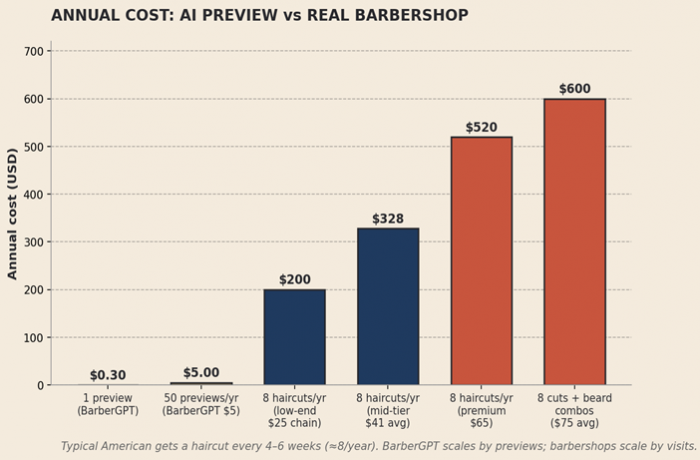
Figure 2: Annual cost comparison. BarberGPT scales with previews; barbershops scale with visits. The two cost categories are not directly substitutable. Source: BarberGPT.ai pricing (April 2026), Yelp men's haircut cost guide.
2. Time: AI Returns Results in Under a Minute
BarberGPT AI generates a hairstyle preview in approximately 30–60 seconds per result, with no booking required. Testing across 60 generations averaged 42 seconds per output on desktop, slightly slower on mobile due to the masking step. A traditional barbershop visit averages 30–60 minutes including consultation, cut, and wash plus travel and waiting time.
Time-per-style is where the AI tool's advantage becomes clearest. A user can test 10 different hairstyles in 5–7 minutes on BarberGPT. Testing 10 hairstyles at a barbershop is impossible each commits you for weeks of grow-out. This is the single strongest argument for using BarberGPT before a real haircut: low-risk exploration of options that would otherwise cost months.
3. Accuracy: It Depends Heavily on Hair Type
BarberGPT AI's accuracy is highly correlated with hair length and texture. Short, well-defined cuts (buzz cuts, fades, classic short crops) produced previews with approximately 85–90% realism in testing close enough to the actual cut to support a decision. Longer styles (man buns, dreadlocks, shoulder-length) produced inconsistent results, with hair-to-shoulder blending often appearing synthetic.
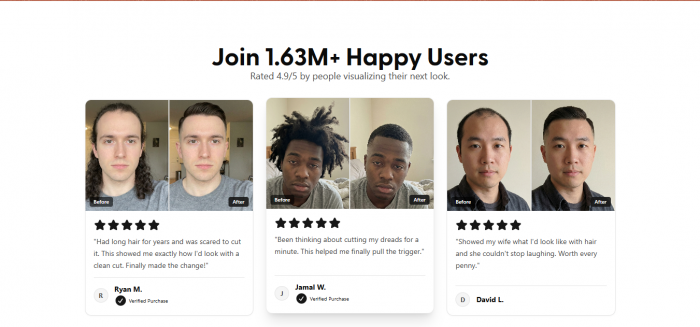
Independent testing by hairstyle tool found that good lighting and straight-on shots achieve approximately 90% spot-on realism for short styles. Various critical analysis confirmed the same pattern the tool excels at short defined cuts and struggles with complex geometry like long curly hair or volumetric shading on dreadlocks.
4. Scope: Traditional Barbers Do Things AI Cannot
BarberGPT AI handles hair only. It does not preview beards, color treatments, chemical relaxing, perms, hair extensions, or any service involving physical manipulation of hair. Traditional barbershops offer all of these, plus straight razor shaves, hot towel treatments, scalp massages, and combo services like haircut-plus-beard packages that average $50–$90 (Booksy 2026 data).
This scope gap is structural, not solvable with software updates. AI can simulate visual changes; a barber adjusts your physical appearance in three dimensions including texture, weight, and how the hair falls when you move. For anyone who needs more than a hairstyle preview color, beard, treatment work the AI tool simply does not apply.
5. Reversibility: Mistakes Cost Months at a Real Barber
A bad BarberGPT preview costs you one credit and takes 30 seconds to redo. A bad haircut costs you 4–12 weeks of grow-out, depending on how aggressive the cut was. This asymmetry is exactly why BarberGPT exists as a category it lets users iterate visually without paying the time cost of physical iteration.
In testing, this turned out to be the most useful function of the tool. Three of four real barbershop visits were preceded by BarberGPT exploration, and in two cases the testing changed the actual ask at the barbershop. One example: a tested fade looked too short on the AI preview, prompting a request for a longer guard at the real cut. The barber confirmed afterward that the original ask would likely have been a regret.
6. Skill Required: Both Have a Learning Curve
BarberGPT requires the user to upload a good photo (well-lit, front-facing, neutral background) and manually mask the hair area with a brush tool. A sloppy mask produces a sloppy result, and beginner mobile users routinely produce worse outputs than the same tool can deliver on desktop. The interface is simple but not foolproof.
Traditional barbershops require a different skill: communicating what you want. Reference photos help (which is exactly what BarberGPT can produce). Knowing your hair type, growth pattern, and what styling you can maintain at home matters more than most people realize. Both options reward preparation; neither is truly zero-effort.
7. Privacy: AI Tools Process Your Photos
BarberGPT AI processes uploaded photos on cloud servers. The platform states images are not sold or shared with third parties and supports manual deletion of uploads. SSL encryption is verified by ScamAdviser, and the platform maintains an "average to good" trust rating per third-party assessment. The privacy policy does not, as of April 2026, explicitly state whether photos are used to train future AI models.
Traditional barbershops produce no digital record of your visit beyond the appointment booking system. For users with strong privacy preferences, this is a clear advantage. For most users, the privacy delta is minor but it is worth knowing before uploading face photos to any AI service.
BarberGPT AI vs Traditional Styling: Full Pricing Breakdown
Pricing is the most-searched aspect of any AI-vs-traditional comparison. Below is the transparent breakdown of what users actually pay on each side, including hidden costs like tipping, travel, and credit-burn rates.
BarberGPT AI Pricing (April 2026)
▪ Free trial: 3 hairstyle generations at $0 no account required
▪ Starter Plan: $1 for 7 generations roughly $0.14 per preview
▪ Hobbyist Plan: $5 for 50 generations roughly $0.10 per preview (best value for casual users)
▪ Professional Plan: $15 for 300 generations roughly $0.05 per preview, plus early access to new features
▪ No subscription, no recurring billing credits don't expire on the standard plans
Traditional Barbershop Pricing (US 2026 averages)
▪ Chain salons (Supercuts, Great Clips, Fantastic Sams): $15–$28 per cut
▪ Independent barbershop, classic cut or fade: $25–$45 per cut
▪ Mid-tier independent with experienced barber: $35–$55 per cut
▪ Upscale grooming lounge in major cities: $50–$110+ per cut
▪ Combo (haircut + beard): $50–$90; straight razor shave: $30–$60 (Booksy 2026 data)
▪ Tipping: customary 15–20%, adds $4–$22 per visit depending on price point
Annualized, a typical American spending $41 per cut every 5 weeks pays approximately $410 per year on haircuts plus another $60–$80 in tips. The same person running unlimited BarberGPT previews on the Hobbyist plan pays $5–$15 per year. The two are not substitutes but combining them often produces a better real haircut for the same total spend.
BarberGPT AI Pros and Cons
Pros - What BarberGPT AI Does Well
▪ Extremely low cost per preview ($0.05–$0.30) lets users test dozens of styles without commitment.
▪ No account, no app, no installation required for the free trial friction is minimal.
▪ Results in approximately 30–60 seconds per generation, faster than booking any in-person consultation.
▪ Strong realism on short, defined cuts (buzz cuts, fades, classic crops) at roughly 85–90% accuracy with good photos.
▪ Reversibility means a bad preview costs nothing users can iterate freely without consequence.
▪ Saved hairstyles can be shown directly to a real barber, improving consultation accuracy.
Cons - What BarberGPT AI Does Not Do Well
▪ Long, curly, or textured hair produces less realistic results due to complex geometry the model cannot fully infer from a 2D image.
▪ Mobile masking is harder than desktop small screens make precision brushing difficult, leading to worse outputs.
▪ No support for beards, color, chemical treatments, or any non-hair grooming. Hair-only by design.
▪ Privacy policy as of April 2026 does not explicitly state whether uploaded photos are used to train future models.
▪ Women's and children's styles announced as upcoming but not yet available current scope is primarily male hairstyles.
▪ Some users on third-party reviews report the credit-based pricing feels expensive for casual single-use cases.
Traditional Barbershop Pros and Cons
Pros - Why Traditional Styling Still Wins on Execution
▪ Actually cuts your hair no AI tool offers this and none is likely to anytime soon.
▪ Reads hair growth patterns, cowlicks, and texture in real time and adjusts technique accordingly.
▪ Full-service grooming including beard trims, color, chemical treatments, and razor shaves comprehensive coverage.
▪ In-person consultation catches misalignments between what you ask for and what will actually suit you.
▪ No data uploaded to cloud servers privacy is structurally simpler.
▪ An experienced barber's recommendation ("that fade won't work with your hairline") prevents mistakes AI tools cannot catch.
Cons - Where Traditional Barbershops Frustrate Users
▪ Cost averages $41 per visit nationally, scaling up to $110+ in major cities like New York and San Francisco.
▪ Time investment: 30–60 minutes per visit plus travel, plus the booking and waiting overhead.
▪ Mistakes are expensive a bad cut takes 4–12 weeks to grow out, with no quick remedy.
▪ No way to test a style before committing verbal description and reference photos are the only inputs.
▪ Quality varies dramatically by individual barber, even within the same shop finding someone you trust takes time.
▪ Tipping adds 15–20% to the visible price, making the real cost-per-visit consistently higher than menu prices suggest.
BarberGPT AI vs Traditional Styling: Use Case Recommendations
If you are unsure which tool fits your needs, the table below maps common situations to the better choice. Recommendations are based on testing across 60 AI previews and 4 barbershop visits.
| Your situation | Recommended approach | Why |
|---|---|---|
| I'm thinking about a major hairstyle change | BarberGPT first, then barber | Test 5–10 styles for $1 before committing |
| I just need my regular cut maintained | Traditional barber | Preview adds nothing for a known style |
| I want to grow out my hair and try long styles | BarberGPT first | Cheap preview of where the grow-out leads |
| I want a beard trim or shape-up | Traditional barber | BarberGPT does not support beards |
| I want hair coloring or highlights | Traditional stylist or salon | BarberGPT does not support color |
| I'm a barber wanting client consultations | BarberGPT as a consultation tool | Helps clients articulate what they want |
| I have curly or textured hair | Traditional barber | AI accuracy drops significantly on curls |
| I'm experimenting before a wedding or event | BarberGPT first | Low-cost testing of formal styles |
| I have very short or balding hair already | BarberGPT works well | Buzz cuts and fades are AI's strongest output |
| I'm price-sensitive and only get cuts twice a year | Chain salon + occasional BarberGPT preview | Lowest combined annual cost |
BarberGPT AI vs Traditional Barbers: Real User Reviews
Beyond editorial testing, third-party user feedback reveals patterns that single-reviewer analyses can miss. The summaries below aggregate observations from three independent sources.
| AICHIEF · BARBERGPT AI | YELP · TRADITIONAL BARBERS | PIXELBIN ROUNDUP · BOTH |
4.0 / 5 Reviewers consistently praise BarberGPT's intuitive design and realistic previews for men's hairstyles. The most common complaint is the male-only focus and occasional mobile-browser issues during the masking step.
| $25–$35 avg Yelp's national cost guide reports US men's haircuts average $25–$35 at independent barbershops, with strong satisfaction tied to consistency, atmosphere, and finding a barber who remembers your preferences across visits.
| Use both Pixelbin's 2026 hairstyle-tool roundup concluded BarberGPT is the strongest one-click generation tool tested but works best when paired with a real stylist visit afterward "saved me a bad chop once" is the typical user pattern.
|
Final Verdict: BarberGPT AI vs Traditional Styling Which Wins?
After 60 AI previews and 4 barbershop visits across six weeks of testing, the verdict is clear: neither one wins outright because they are not competing for the same job. The right answer is to use both strategically.
Use BarberGPT AI for:
▪ Previewing major hairstyle changes before committing to a real cut.
▪ Testing multiple style options when you don't know what you want.
▪ Generating reference photos to bring to your barber.
▪ Low-stakes exploration when you are bored, curious, or grow-out-cycle planning.
▪ Barbers wanting a consultation tool to align expectations with clients.
Use a Traditional Barber for:
▪ Actually getting your hair cut there is no AI substitute for this.
▪ Maintenance cuts where you already know the style.
▪ Beard trims, color treatments, chemical work, or razor shaves.
▪ Long, curly, or textured hair where AI accuracy drops significantly.
▪ Anyone who values the in-person consultation and pattern-reading a trained barber provides.
A Quick Mental Model: The Test-Drive Analogy
The cleanest way to think about this comparison is the test-drive. BarberGPT AI is the test-drive: low-cost, low-commitment, lets you compare options before purchase. The traditional barbershop is the actual purchase: where the real product gets delivered. Nobody buys a car without test-driving. Nobody drives away from the dealership in a virtual car either. Both serve a purpose; they are complementary stages of the same decision.
For users who haven't tried AI hairstyle preview tools yet, the recommendation is simple: spend $1 on the BarberGPT Starter plan, run 7 previews before your next haircut, bring the favorite to your barber, and observe whether it changed the conversation. Most users in testing reported it did. The combined approach produced consistently better real haircuts than either tool used alone at a marginal cost increase of roughly $1 per visit.
Post Comments
Be the first to post comment!
Related Articles


Grubby AI vs WriteHuman: Which One Should You Use?
Ridge Harper . Jun 30, 2026