Table of Content
- What Is Valant.io?
- What Is TherapyNotes?
- Side-by-Side Comparison at a Glance
- Feature Score Comparison
- Feature by Feature Breakdown
- Pricing Comparison
- Edge Cases and Real-World Limitations
- Pros and Cons of Each Platform
- Practice Fit by Use Case
- Which Platform Suits Which Practice?
- Compliance, Security, and Responsible Use
- Final Verdict
- Conclusion
Valant.io and TherapyNotes are two of the most frequently shortlisted electronic health record platforms in the behavioral health space, and the choice between them is rarely as close as their feature lists make it appear. TherapyNotes is the de facto starting point for solo therapists and small group practices that want a clean, structured documentation workflow with predictable monthly pricing. Valant.io is the platform mid-sized clinics, psychiatric practices, and Intensive Outpatient Programs reach for when therapy-only EHRs start hitting their ceiling.
The decision is rarely about which platform is universally better. It is about practice size, prescriber workload, billing complexity, and how much the practice plans to grow over the next two to three years. A clinic that picks the wrong tool ends up either paying for capabilities it does not use or hitting walls every quarter on a system that was never designed for its workflow. The comparison that follows separates the two platforms by what they actually do well, where each one breaks under stress, and which kind of practice gets the most value from each.
Quick verdict: TherapyNotes is the stronger choice for solo therapists, counselors, and small group practices that want predictable pricing, structured note templates, and fast onboarding. Valant.io is the stronger choice for psychiatric practices, mid-sized to large behavioral health groups, IOP and PHP programs, and any clinic where prescribing, complex billing, or multi-level care is part of the daily workflow. The break point sits roughly around 10 clinicians or the moment prescribers join the team.
What Is Valant.io?

Valant.io, the public-facing brand of Valant Medical Solutions, is a cloud-based electronic health record and practice management platform built specifically for behavioral health. The vendor is headquartered in Seattle and has positioned itself as a specialty EHR rather than a general medical platform retrofitted for therapy and psychiatry. The product covers clinical documentation, scheduling, billing, e-prescribing, telehealth, outcome measurement, and a patient portal called MYIO under one cohesive system.
The platform is designed around the workflows specific to behavioral health: modality-based note templates, more than 80 patient-reported outcome measures that integrate directly into clinical notes, and dedicated workflows for higher levels of care including Intensive Outpatient Programs and Partial Hospitalization Programs. E-prescribing is integrated with PDMP lookups and supports EPCS for controlled substances, which matters for any clinic with prescribers on staff. Valant also offers an optional dedicated billing services team that handles the revenue cycle on behalf of the practice, an offering that mid-sized clinics often find more valuable than the EHR itself.
Valant does not publish list pricing. Public references on Software Finder and partner sites estimate the platform in the range of USD 100 to USD 300 per month, with add-on charges possible for e-prescribing, faxes, and API usage. The platform offers a live or recorded demo rather than a free trial, which means evaluation depends on a scheduled sales conversation. Reviews on Capterra and Software Advice describe Valant as well-suited to behavioral health workflows but flag occasional slow performance, a somewhat dated interface, and clearinghouse integration friction that has affected claim processing in some practices.
What Is TherapyNotes?

TherapyNotes is a cloud-based EHR and practice management platform founded in 2010 by Dr. Debra Pliner and Brad Pliner in Horsham, Pennsylvania. The product is purpose-built for behavioral health and is widely cited as the most popular EHR for solo therapists and small group practices. Its design philosophy treats clinical documentation as the central feature rather than an afterthought, with structured DAP, SOAP, and BIRP note templates, DSM-5 diagnosis integration, and supervisor approval workflows that suit early-career clinicians and training environments.
The platform combines scheduling, documentation, electronic insurance claims, ERA payment posting, credit card processing, a patient portal, and HIPAA-compliant telehealth into a single integrated system. Pricing is published transparently: USD 69 per month for solo providers, with group plans starting at USD 79 per month for the first clinician and USD 50 for each additional clinician. There are no setup fees, implementation fees, or data migration charges, and a 30-day free trial allows full evaluation before commitment.
In hands-on review and across user feedback on G2, Capterra, and Software Advice, TherapyNotes consistently rates highly for ease of use, customer support, and clinical documentation quality. The platform’s phone-based support is repeatedly singled out as a differentiator. The recurring criticism is that the product evolves slowly, with reporting and customization capabilities lagging more modern competitors, and that practices growing beyond about 10 clinicians eventually outgrow it. A long-form review on Crown Counseling describes adopting TherapyNotes for a small practice and supplementing it with PracticeVital and manual workarounds once the practice reached 40 users, which captures the ceiling well.
Side-by-Side Comparison at a Glance
The table below summarizes the most important practical differences between Valant.io and TherapyNotes. A deeper feature-by-feature breakdown follows.
| Aspect | Valant.io | TherapyNotes |
|---|---|---|
| Vendor | Valant Medical Solutions, Seattle, Washington | TherapyNotes, LLC, Horsham, Pennsylvania |
| Founded | Established behavioral health EHR vendor | Founded in 2010 by Dr. Debra Pliner and Brad Pliner |
| Primary Audience | Mid-sized to large behavioral health practices, IOP/PHP, psychiatry | Solo therapists, counselors, and small group practices |
| Deployment | Cloud-based, web with provider and patient mobile app | Cloud-based, web with mobile app |
| Pricing Model | Quote-based; estimated USD 100–300 per month per public sources | Published flat per-clinician pricing starting at USD 69 per month |
| Free Trial | No free trial; demo available on request | 30-day free trial of full platform |
| Clinical Documentation | Modality-specific templates, narrative-generating notes, 80+ outcome measures | Structured DAP, SOAP, BIRP templates with DSM-5 integration |
| E-Prescribing | Integrated e-prescribing with PDMP integration; EPCS supported | Basic e-prescribing through partner integration |
| Insurance Billing | Integrated billing plus optional dedicated revenue cycle management team | Integrated billing, electronic claims, ERA posting, no setup fees |
| Telehealth | Built-in HIPAA-compliant telehealth | Built-in HIPAA-compliant telehealth |
| IOP/PHP Support | Dedicated workflows for Intensive Outpatient and Partial Hospitalization | Limited; not designed for higher levels of care |
| Implementation | Guided implementation with onboarding support | Self-serve setup; most solo practices live within one to three days |
| Best For | Practices with prescribers, multi-level care, complex billing | Solo and small group therapy practices that want simplicity and predictable cost |
Feature Score Comparison
The chart below scores both platforms across nine categories that drive most behavioral health EHR purchase decisions. Scores synthesize platform capabilities, verified user reviews on Capterra, G2, and Software Advice, and direct feature documentation from each vendor’s site.
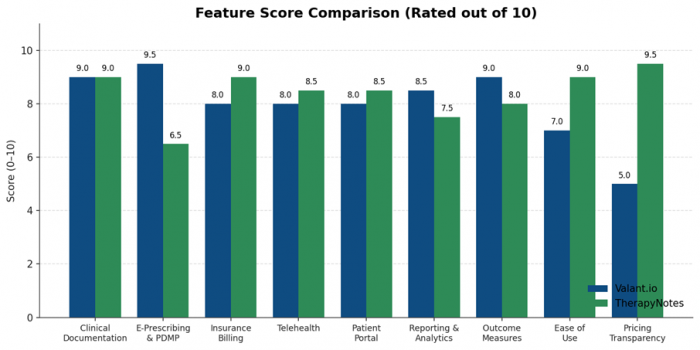
The pattern is unambiguous. Valant.io leads on e-prescribing, outcome measures, and clinical depth that suits prescribers and complex programs. TherapyNotes leads on ease of use, pricing transparency, and core insurance billing. Both platforms tie on clinical documentation quality, although they take very different approaches to it.
Feature by Feature Breakdown
1. Clinical Documentation
Both platforms treat clinical documentation as a flagship feature. TherapyNotes uses structured DAP, SOAP, and BIRP templates with DSM-5 diagnosis integration and supervisor approval flows. The structure is opinionated, which suits clinicians who want guided documentation that reduces the chance of incomplete notes. The trade-off is that practices needing documentation formats outside these standards find the system constraining.
Valant.io offers modality-specific note templates, narrative-generating documentation, and AI-assisted note generation in newer releases. The platform integrates more than 80 patient-reported outcome measures directly into clinical notes, which is valuable for clinics tracking progress data for payers or research. Reviews on Capterra describe note completion times averaging 90 to 120 seconds with structured forms, although other users report the clinical forms can feel unwieldy and lacking logical flow in specific scenarios. The difference in approach is real: TherapyNotes optimizes for the individual therapist; Valant optimizes for clinical depth and reportable outcomes.
2. E-Prescribing and Medication Management
This category exposes the clearest gap between the two platforms. Valant.io provides integrated e-prescribing with PDMP lookups and EPCS support for controlled substances, which makes it suitable for psychiatrists, psychiatric nurse practitioners, and any prescribing clinician. The medication module supports drug interaction checks, formulary information, and electronic refill management as part of the clinical workflow.
TherapyNotes supports basic medication tracking and offers e-prescribing through partner integration, but the platform is not designed as a prescriber-first tool. EHR Source’s 2026 review states this directly, recommending Valant for any practice where prescribing is core to the clinical model. Solo therapists and counselors without prescribing responsibilities will not feel this gap. Practices with prescribers on staff will encounter it on day one.
3. Insurance Billing and Revenue Cycle
TherapyNotes offers integrated billing with electronic insurance claims, ERA payment posting, automated superbill generation, and a credit card processing module. The implementation has a strong reputation among solo and small group practices for being predictable. There are no setup or migration fees, and reviewers on G2 consistently describe billing as one of the platform’s strengths.
Valant.io includes integrated billing and offers an optional dedicated revenue cycle management team that handles claims, denials, and reimbursement timelines on the practice’s behalf. That offering is particularly valuable for mid-sized clinics that lack in-house billing expertise. The caveat is that some Capterra reviewers describe friction with Valant’s clearinghouse integration, with at least one practice reporting months of denied claims tied to integration issues. Practices considering Valant should weigh the dedicated billing team option carefully and ask the sales team for current clearinghouse compatibility specifics.
4. Telehealth, Patient Portal, and Patient Engagement
Both platforms include HIPAA-compliant telehealth launched directly from the scheduling calendar. The user experience is similar across both: appointment-driven video sessions with no separate licensing required. TherapyNotes’ telehealth is described as reliable, with occasional interruptions resolved quickly through support. Valant’s telehealth is integrated into the broader provider workflow.
TherapyNotes ships a patient portal that supports intake, consent forms, appointment scheduling, payments, and secure messaging. Valant’s MYIO patient portal covers similar ground with an emphasis on integrated patient communications and online bill pay. For most practices, both portals satisfy the core engagement needs, although Valant’s offering tends to feel more cohesive when paired with the rest of the suite, while TherapyNotes’ portal has the advantage of simpler setup.
5. Reporting, Analytics, and Outcome Measures
Valant.io invests more heavily in this category. The integration of more than 80 outcome measures into clinical notes, combined with reporting on both clinical and financial outcomes, supports practices that need to demonstrate clinical effectiveness to payers, accreditation bodies, or internal stakeholders. Reports cover practice performance, utilization review, eligibility checking, and progress tracking across providers.
TherapyNotes provides reporting with strong filtering by provider and payer, but multiple G2 reviewers note that data manipulation typically requires exporting reports to a separate tool. For practices with simple reporting needs, this is acceptable. For practices that need to slice data by program type, level of care, or population segment, the export-then-analyze workflow becomes a bottleneck. Long-form reviews from group practices describe supplementing TherapyNotes with third-party tools such as PracticeVital to fill the analytics gap.
6. Implementation, Onboarding, and Support
TherapyNotes is one of the fastest behavioral health EHRs to implement. Most solo practitioners are operational within one to three days, and there are no setup, implementation, or data migration fees. Phone-based customer support is widely cited as a differentiator. Reviews consistently describe the support team as friendly, knowledgeable, and quick to escalate issues.
Valant offers structured onboarding through a dedicated implementation process, which matches its target audience of mid-sized to large practices that need configuration support. The vendor pitches strong implementation support and responsive help desk service, and many user reviews echo this. Other reviews describe slower response times in specific departments, particularly accounting, and a preference for email rather than phone communication that some users find frustrating. The pattern that emerges is that Valant’s support is solid but more variable than TherapyNotes’, partly because the product surface area is larger.
Pricing Comparison
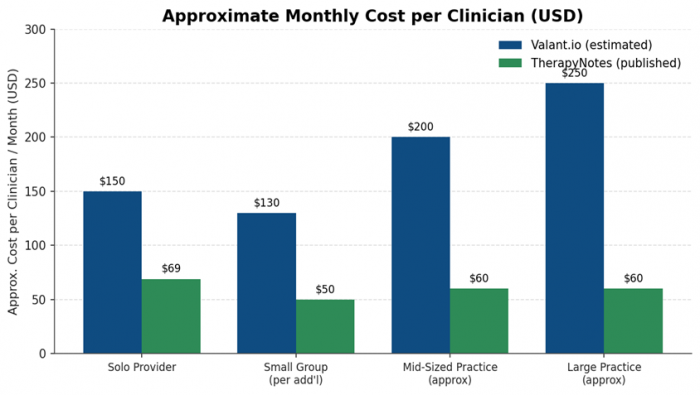
Pricing is one of the clearest practical differentiators between the two platforms. TherapyNotes publishes its pricing openly. Valant uses a quote-based model that requires sales engagement to receive a number. The chart below visualizes approximate per-clinician monthly costs across practice sizes, using TherapyNotes’ published rates and the public estimates available for Valant.
The detailed pricing matrix below adds context on what each platform charges for, where add-ons appear, and how setup costs differ.
| Cost Element | Valant.io | TherapyNotes | Notes |
|---|---|---|---|
| Base Price | Custom quote (estimated USD 100–300 / clinician / month) | USD 69 / month for solo, USD 79 first clinician for groups | Valant requires sales contact; TherapyNotes lists pricing publicly |
| Additional Clinicians | Per-provider pricing per quote | USD 50 per additional clinician per month | TherapyNotes scales linearly and predictably |
| Implementation Fees | May apply; varies by practice size | No setup, implementation, or data migration fees | TherapyNotes assists with data import at no extra cost |
| Add-on Fees | E-prescribing, faxes, and API usage may incur add-ons | Telehealth and patient portal included; e-prescribing add-on optional | Verify add-ons during sales discovery |
| Free Trial | Not offered; live or recorded demo only | 30-day free trial of full platform | TherapyNotes offers lower-friction evaluation |
| Annual Discount | Negotiable in quote | No published annual discount | Negotiate at quote stage on Valant |
Two practical observations emerge. First, TherapyNotes is the meaningfully cheaper option at every practice size for therapy-only workflows, particularly given the absence of setup fees and the inclusion of telehealth at the base price. Second, Valant’s higher cost reflects both broader feature coverage and the optional revenue cycle management team. Practices that would otherwise hire an in-house biller or contract one externally may find the math closer than the headline numbers suggest, but the comparison only works once a quote is obtained directly from Valant.
Edge Cases and Real-World Limitations
Most published comparisons stop at the headline feature list. The behaviors below tend to surface only after extended use and frequently determine whether a practice stays on a platform long term.
Performance and reliability under load
Capterra and Software Advice reviews of Valant.io consistently mention occasional slow performance, with multiple users describing system instability that has impacted day-to-day operations. At least one detailed review attributes lost revenue to platform downtime. TherapyNotes is generally praised for stability, although G2 reviewers note that telehealth interruptions occur occasionally and are typically resolved through support. Practices in regions with less reliable internet or those running back-to-back sessions should weigh stability heavily and test it during a free trial or demo period.
Customization ceiling
TherapyNotes’ structured note templates are a strength for clinicians who want guided documentation, but the customization ceiling is real. Practices that follow clinical models requiring documentation outside DAP, SOAP, and BIRP structures find the platform limiting. Valant offers more configurability in note templates and outcome measures but at the cost of a steeper setup curve. Neither platform competes with EHRs that expose API access for deep customization, although Valant’s feature set lands closer to that ceiling.
Scaling beyond 10 clinicians
TherapyNotes is widely described as ideal for solo and small group practices and as constraining for larger groups. Reviews from practices with 20 or more clinicians describe needing to supplement TherapyNotes with third-party reporting and analytics tools to maintain operational visibility. Valant is built for this segment from the start, with multi-provider scheduling, multi-site support, and program-level workflows for IOP and PHP.
Clearinghouse and billing integration friction
Insurance billing is rarely friction-free on any EHR, but the specific issues differ. Valant reviewers have flagged Change Healthcare integration challenges that resulted in months of denied claims requiring an appeals process for at least one Capterra-reviewed practice. TherapyNotes handles its own clearinghouse integration with a generally smooth claims experience but reviewers note the absence of features such as integrated secondary billing and ROI workflows.
Reporting depth versus operational visibility
Valant’s outcome measure integration and clinical and financial reporting are stronger than TherapyNotes’ in absolute terms. The trade-off is complexity: more powerful reporting demands more configuration. TherapyNotes’ reporting is simpler and faster to use for straightforward queries, but demands export-and-analyze workflows for anything beyond standard practice metrics. Practices should map their reporting needs against each platform before committing.
Vendor evolution velocity
Long-form reviews on Crown Counseling and EHR Source describe TherapyNotes as evolving slowly relative to newer EHRs. Practices that depend heavily on roadmap delivery should factor this into their evaluation. Valant has shipped AI-assisted documentation and program-level features in recent releases, suggesting a faster product velocity. Neither vendor competes with the rapid release cycles of newer cloud-native challengers, but Valant’s pace currently appears to be the higher of the two.
Pros and Cons of Each Platform
Valant.io
| Valant.io — Pros | Valant.io — Cons |
|---|---|
• Purpose-built for behavioral health, including IOP and PHP workflows • Robust e-prescribing with PDMP and EPCS support for psychiatry • Optional dedicated revenue cycle management team • More than 80 patient-reported outcome measures integrated into notes • Narrative-generating clinical documentation reduces note time • AI-assisted documentation features available | • No publicly listed pricing; sales engagement required • Reviewers describe occasional slow performance and a dated interface • Reports of clearinghouse integration issues affecting claims • Customer service responsiveness flagged in some reviews, especially accounting • No free trial; evaluation requires scheduled demo • Steeper learning curve than therapy-only EHRs |
TherapyNotes
| TherapyNotes — Pros | TherapyNotes — Cons |
|---|---|
• Transparent published pricing with no setup or migration fees • Structured DAP, SOAP, and BIRP templates with DSM-5 integration • Strong reputation for live phone-based customer support • Fast implementation: most solo practices live within one to three days • 30-day free trial enables low-risk evaluation • Reliable insurance billing with electronic claims and ERA posting | • Reporting capabilities limited; data exports often required for analysis • Limited fit for higher levels of care such as IOP and PHP • Less robust e-prescribing than psychiatry-focused platforms • Customization of note templates is constrained • Multi-site and multi-location workflows feel constrained at scale • Reviews describe slow product evolution in recent years |
Practice Fit by Use Case
Different practices have different priorities. The chart below scores both platforms against eight practice profiles that frequently appear in EHR shortlists. Scores reflect feature presence, real-world fit reported in user reviews, and the workflows each platform was designed to serve.
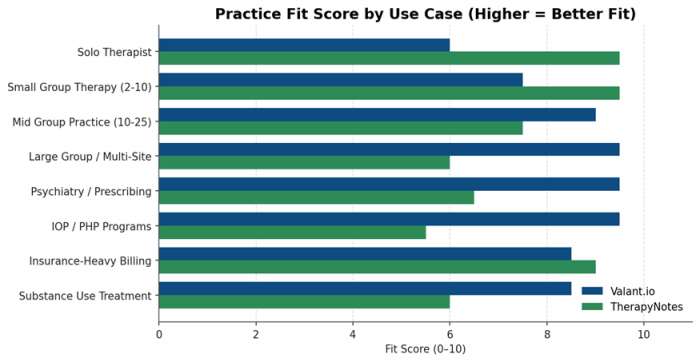
The pattern reinforces the early verdict. TherapyNotes dominates anywhere the practice is small, therapy-only, and oriented toward predictable insurance billing. Valant dominates anywhere the practice has prescribers, multi-level programs, multi-site operations, or complex billing needs. The two platforms cross over in the small-to-mid group practice segment, where the right answer depends primarily on whether prescribers are on the team and how the practice plans to grow.
Which Platform Suits Which Practice?
TherapyNotes is the better fit for:
• Solo therapists, counselors, and licensed clinical social workers in private practice.
• Small group therapy practices of two to ten clinicians without prescribers on staff.
• Practices that need predictable, transparent monthly pricing without sales engagement.
• Clinicians transitioning from paper records who need a fast, low-friction first EHR.
• Practices that bill insurance and need dependable claims management without a dedicated biller.
Valant.io is the better fit for:
• Mid-sized to large behavioral health practices, typically ten or more clinicians.
• Psychiatric practices and prescribing clinicians who need integrated e-prescribing and PDMP support.
• Clinics offering Intensive Outpatient Programs or Partial Hospitalization Programs.
• Practices that prefer outsourced revenue cycle management through the vendor.
• Multi-site, multi-provider organizations with complex scheduling and reporting requirements.
Compliance, Security, and Responsible Use
Both Valant.io and TherapyNotes are built around HIPAA-compliant data handling, secure login, encrypted storage, and the role-based access controls expected in clinical EHRs. Both platforms publish privacy and terms of service documents on their official sites, and both cover the standard EHR security expectations for behavioral health practices in the United States.
That said, HIPAA compliance is necessary but not sufficient. Practices should verify Business Associate Agreements directly with each vendor, confirm encryption standards in transit and at rest, validate audit log retention against state-specific requirements, and review breach notification policies before signing. Practices treating substance use populations should pay specific attention to 42 CFR Part 2 compliance, which is more stringent than HIPAA and has implications for both consent and disclosure workflows. Neither vendor should be assumed to handle 42 CFR Part 2 by default; explicit confirmation during the sales process is essential.
Final Verdict
The honest answer to "Valant.io vs TherapyNotes" is that this comparison is rarely about which platform is universally better. It is about which platform fits the practice. TherapyNotes is the right answer for the majority of solo therapists, counselors, and small group practices that want a clean, structured documentation workflow, predictable pricing, and fast onboarding. Valant.io is the right answer for psychiatric practices, mid-sized to large behavioral health groups, IOP and PHP programs, and any clinic where prescribing or complex billing is part of the daily reality.
Practices on the boundary, typically small group practices considering future growth, should evaluate both platforms during the discovery phase. TherapyNotes’ 30-day free trial allows direct hands-on testing without commitment. Valant’s demo process offers depth but requires sales engagement and a custom quote. The strongest decision-making framework is to map the next two to three years of expected practice growth, identify where prescribers and higher levels of care fit, and pick the platform whose ceiling sits comfortably above projected needs rather than just clearing current ones.
Conclusion
Valant.io and TherapyNotes are both credible behavioral health EHR platforms, and both have earned strong reputations within the segments they were designed to serve. The decision between them is best framed as a fit question rather than a quality question. Practice size, prescribing workload, billing complexity, and growth trajectory determine which platform supports the work and which one constrains it.
Whichever platform a practice selects, regulatory compliance, security, and ongoing vendor due diligence remain essential. The behavioral health software space evolves quickly. Pricing pages, integrations, and feature roadmaps change without notice, and every claim in this guide should be re-verified against the official sources listed in the next section before any meaningful subscription commitment.
Post Comments
Be the first to post comment!
Related Articles