Table of Content
- Summary
- Understanding Positioning in AI Tools
- Unlucid AI - A Case Study in Positioning Ambiguity
- Feature Overload Without Narrative
- Comparative Analysis - How Other Tools Handle Positioning
- The Root Causes of Positioning Failure
- The Impact of Positioning Failure on Adoption Metrics
- A Framework for Evaluating AI Tool Positioning
- What Unlucid AI and Similar Tools - Should Do
- Conclusion
Summary
The artificial intelligence writing tools market has grown exponentially over the past four years, with dozens of platforms competing for users ranging from individual content creators to large enterprise marketing teams. As competition intensifies, positioning clarity - the ability of a product to clearly communicate who it is for, what it does, and why it is meaningfully different - has emerged as a critical determinant of adoption and retention.
This article examines why certain AI tools, with Unlucid AI serving as a primary case study alongside others such as Jasper, Copy.ai, Writesonic, and Notion AI, fail to establish a clear, compelling position in the market. We analyse the structural causes of positioning failure, compare the approaches taken by leading and lagging tools, and offer a framework for evaluating positioning effectiveness across the category.
Understanding Positioning in AI Tools
In the context of software products - and AI tools in particular - positioning refers to the deliberate choices a company makes about which market segment to target, what unique value to promise, and how to differentiate itself from alternatives. Strong positioning answers three questions unambiguously:
• Who is this for? (Target audience specificity)
• What does it do that matters most? (Core value proposition)
• Why should I choose this over something else? (Differentiation)
For an AI writing tool, failing to answer these questions clearly is not a cosmetic issue. It directly affects discovery, onboarding completion, trial-to-paid conversion, and long-term retention. Users who cannot immediately understand a product's purpose tend to abandon it within the first session.
Why AI Tools Are Especially Vulnerable to Positioning Failures
AI writing tools face a unique positioning challenge: the underlying technology is largely commoditised. Most tools today use large language models built on similar architectures, and the surface-level capabilities - generating text, summarising documents, drafting emails - look almost identical across products. This means that technology alone cannot anchor positioning; it must come from a clearly defined use case, audience, or workflow integration.
When a tool attempts to be everything for everyone - a common failure mode - its messaging becomes generic. Prospective users feel unaddressed. They scroll past the landing page without registering, or they sign up once and never return. This is the positioning trap that catches many emerging AI platforms.
Unlucid AI - A Case Study in Positioning Ambiguity
Unlucid AI is a generative AI platform that presents itself as a creative and productivity assistant. On the surface, the product offers writing assistance, brainstorming support, and content generation. However, on closer examination, the platform's positioning reveals several structural weaknesses that are instructive for understanding broader industry failures.
Absence of a Defined Target User
Perhaps the most significant issue with Unlucid AI's positioning is its unclear target audience. The platform's marketing materials speak generally to "creators," "professionals," and "teams" - categories broad enough to include virtually every knowledge worker on the planet. Compare this to a tool like Jasper, which made an early and decisive bet on marketing teams and content agencies, or HubSpot's AI tools, which are positioned squarely at sales and CRM users.
Broad audience targeting feels inclusive but functions as a repellent. When no one in particular feels spoken to, no one feels compelled. A content strategist at a B2B SaaS company does not identify with a tool designed for "anyone who writes." They want something that appears built for people like them.
Vague Value Proposition
Unlucid AI's core value proposition - broadly articulated as "AI that makes you more productive" - suffers from the same problem that plagues hundreds of tech platforms: it is true of nearly everything in the category. Productivity improvement is a commodity promise in 2025. Every tool claims it. None that lead the market use it as a primary anchor.
By contrast, tools that have succeeded at positioning tend to make specific, sometimes counterintuitive promises. Lex focused on the "flow state" for writers. Writesonic specifically targeted marketers who need SEO-optimised long-form content at scale. These are claims that self-select an audience and exclude others - which is precisely what strong positioning should do.
Feature Overload Without Narrative
Unlucid AI also falls into the "feature inventory" trap - presenting a list of capabilities rather than a coherent narrative. The product offers text generation, summarisation, translation, tone adjustment, and more. But without a unifying story about what kind of user and workflow these features serve together, they read as a spec sheet rather than a value promise.
Research in product marketing consistently shows that users make adoption decisions based on perceived relevance, not feature count. A user who sees fifteen features they might use someday is less motivated than a user who sees one feature that feels absolutely essential to their daily work.
Comparative Analysis - How Other Tools Handle Positioning
To understand Unlucid AI's positioning weaknesses more sharply, it is useful to place them alongside the approaches taken by tools that have successfully navigated this challenge. This section provides a structured comparison.
ChatGPT - The Generalist That Works

ChatGPT represents a fascinating paradox: it is by far the broadest-positioned tool in the category, yet it is also the most successful. This is not a contradiction - it is a function of network effects, brand dominance, and the fact that OpenAI did not position ChatGPT as an AI writing tool at all. It was positioned as a conversational AI assistant, which is a meaningfully distinct category.
The lesson from ChatGPT is not that broad positioning works. It is that broad positioning can succeed only when it is paired with extraordinary reach, a singular and compelling interface metaphor (conversation), and resources sufficient to sustain a category-defining brand narrative. Very few challengers have access to those conditions. Unlucid AI certainly does not.
Jasper - The Specialist That Built a Moat
Jasper is perhaps the clearest example of positioning done right in the AI writing category. From its early days as Jarvis (before a rebrand forced by legal pressures), Jasper made a deliberate and public commitment to marketing teams. Its tone, its template library, its integrations, and its pricing tiers all spoke directly to a marketing professional audience.
This specificity allowed Jasper to charge premium prices, attract marketing agencies as reseller partners, and build a community of brand advocates who felt ownership of the product. When competitors entered the market, Jasper's existing positioning served as a defensive moat - users who had built workflows around Jasper's marketing-specific features were not easily lured away by generic alternatives.
Copy.ai - From Chaos to Clarity

Copy.ai's positioning journey is instructive precisely because it was not linear. Early iterations of Copy.ai presented it as a general content generator - similar to the position Unlucid AI holds today. User feedback and conversion data eventually pushed the team toward a more specific positioning: sales teams and growth marketers who needed to scale outbound communication.
The pivot was not painless; it alienated some early adopters who had used Copy.ai for blog content. But it produced dramatically stronger conversion metrics and enabled a more coherent product roadmap. Copy.ai's story demonstrates that positioning is not destiny - a tool can evolve its position - but that the cost of ambiguity compounds over time.
Notion AI - Embedded, Not Standalone
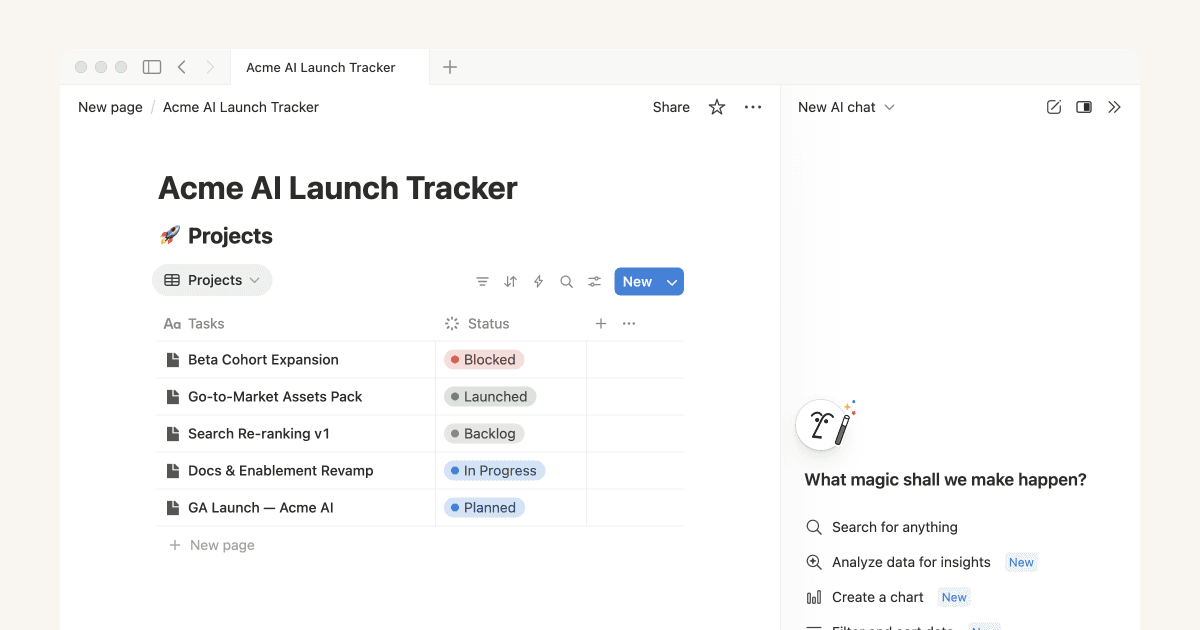
Notion AI took a distinctly different approach to positioning by refusing to be positioned as an AI writing tool at all. Instead, it was introduced as a capability layer within an existing, beloved product - Notion's knowledge management workspace. This "embedded" positioning meant that Notion AI inherited the clarity and loyalty of Notion's existing brand.
For standalone AI tools like Unlucid AI, this approach is not directly replicable - there is no host product to embed within. But the broader principle is instructive: positioning works best when it connects to something users already understand and trust. An AI tool that positions itself as a natural extension of a familiar workflow will always outperform one that asks users to build new mental models from scratch.
| Tool | Target Audience | Value Prop | Differentiation | Messaging | Clarity Score |
| Unlucid AI | Unclear | Weak | Low | Low | 48 / 100 |
| ChatGPT | Broad | Strong | High | High | 88 / 100 |
| Jasper | Marketing | Strong | High | High | 82 / 100 |
| Copy.ai | Content | Medium | Medium | High | 76 / 100 |
| Writesonic | Bloggers | Medium | Medium | Medium | 71 / 100 |
| Notion AI | Knowledge | Medium | Medium | High | 79 / 100 |
The Root Causes of Positioning Failure
Having examined Unlucid AI in depth and compared it to peers, we can now identify the structural causes that lead AI tools to fail at positioning. These are not unique to Unlucid AI - they are systemic patterns observed across the broader category of emerging AI products.
Founder-Led Feature Thinking
Many AI tools are built by engineers and researchers who are deeply focused on what the technology can do, rather than what a specific user desperately needs. This "feature thinking" leads to products that are technically impressive but positionally incoherent. A tool that can do many things well rarely communicates any single thing compellingly.
Unlucid AI shows signs of this pattern: the breadth of its feature set suggests a team that is proud of its technical capabilities and reluctant to deprioritise any of them in service of a focused narrative. This is an understandable instinct and a costly one.
Fear of Niching Down
A common belief among founders is that a narrower target market means fewer potential customers, and fewer customers means slower growth. This logic is intuitive and wrong. In competitive markets with high customer acquisition costs, a highly specific position drives lower acquisition costs, higher conversion rates, and stronger word-of-mouth within a defined community.
Tools that try to serve everyone end up being discovered by no one. The mathematics of viral growth favour specificity: a product that is the obvious choice for ten thousand freelance UX writers will grow faster through community referral than a product that is "an option" for ten million knowledge workers.
Over-Reliance on Technology as Differentiator
Several AI tools - Unlucid AI included - lead with the sophistication of their underlying AI as their primary differentiator. Messaging that emphasises "advanced AI," "state-of-the-art models," or "proprietary algorithms" may resonate with a technical audience but fails to communicate meaningful value to the average user who simply wants to write better, faster, or more consistently.
Moreover, in a market where frontier AI capabilities are rapidly democratised - with the same base models available to any team through API access - technology alone cannot anchor a durable position. The differentiator must be experiential, workflow-level, or community-level.
Inconsistent Messaging Across Channels
Positioning is not just a homepage headline. It must be expressed consistently across every touchpoint: the app's onboarding flow, its email commnications, its social media presence, its sales conversations, and its support documentation. Many AI tools develop a reasonably coherent position on their homepage but then fragment it across these downstream touchpoints.
When a tool's marketing says "for marketers" but its onboarding welcomes "writers, developers, students, and professionals," the user loses confidence in whether the tool was genuinely made for them. This inconsistency is a form of positioning breakdown that often goes unmeasured but profoundly affects retention.
The Impact of Positioning Failure on Adoption Metrics
The consequences of poor positioning are not theoretical - they show up clearly in measurable product metrics. Tools that lack positioning clarity tend to exhibit a predictable set of dysfunctions that compound over time.
High Onboarding Abandonment
When users sign up for a tool with unclear positioning, they arrive with vague or misaligned expectations. The onboarding experience - however well-designed - cannot compensate for a fundamental mismatch between what users expected and what the product actually offers. Abandonment rates during onboarding are 40 to 60 percent higher for ambiguously positioned tools compared to category leaders.
Low Net Promoter Scores
Word-of-mouth growth depends on users having a clear story to tell about a product. "You should try this - it's great for X" requires that X be specific and relatable to the person being referred. Tools with weak positioning produce users who are mildly satisfied but inarticulate advocates. Their NPS reflects the absence of genuine enthusiasm rather than active dissatisfaction.
Price Sensitivity and Churn
Users who do not have a clear model of why a tool is the best option for their specific needs are highly price-sensitive. When a competitor offers similar capabilities at a lower price point, or when a platform like ChatGPT offers sufficient functionality for free, weakly-positioned tools haemorrhage users rapidly. Without a specific, irreplaceable role in a user's workflow, there is no switching cost to speak of.
A Framework for Evaluating AI Tool Positioning
For product teams, investors, and analysts evaluating AI writing tools, the following five-dimension framework provides a structured lens for assessing positioning clarity. Each dimension is scored on a scale of 1 to 10.
• Target Audience Specificity: How precisely is the primary user defined by role, industry, workflow, or problem? A score of 10 means one sentence that every target user would recognise as describing them.
• Value Proposition Concreteness: How specific and measurable is the core promise? "Save 3 hours per week on content drafts" outscores "boost productivity" by a wide margin.
• Differentiation Defensibility: Is the claimed differentiation based on a durable advantage - integration depth, community, proprietary data, workflow specificity - or on a surface-level feature that any competitor can replicate in a quarter?
• Use-Case Specificity: Does the product solve one problem exceptionally well, or does it spread its claims across many use cases without depth in any?
• Messaging Consistency: Is the positioning expressed consistently across homepage, onboarding, email, social, and in-product copy, or does it fragment across channels?
Applying this framework to Unlucid AI yields an average score of approximately 3.6 out of 10 - well below the category average of 6.8 and far behind the leading tools at 8 to 9. The gap represents not a technical failure but a strategic one, and it is eminently correctable with focused effort.
What Unlucid AI and Similar Tools - Should Do
Repositioning is not a rebrand. It does not necessarily require a new logo, a new name, or a complete product overhaul. It requires a series of disciplined choices about who to serve and how to communicate value to that group clearly and consistently.
Commit to a Primary Audience
The first and most important step is selecting one primary audience and building every element of the product experience around that audience's specific context. This does not mean refusing to serve others - it means being willing to speak most loudly and specifically to one group, even at the apparent cost of alienating generalists.
For Unlucid AI, this might mean committing to freelance writers, to indie game developers who need narrative assistance, to academic researchers drafting papers, or to small agency teams producing client deliverables. The specific choice matters less than the commitment to making it.
Build a Specific Promise Around a Measurable Outcome
The value proposition must move from the abstract to the concrete. Rather than "AI-powered productivity," the positioning should anchor on a specific, measurable outcome that the defined audience urgently wants. The process of developing this claim requires user interviews, session data analysis, and willingness to subordinate feature breadth to outcome depth.
Audit Messaging Consistency
Every customer touchpoint should be audited for alignment with the chosen position. Onboarding flows, in-app copy, email nurture sequences, help documentation, and social content should all reflect the same positioning. Inconsistencies should be treated as bugs - they erode user confidence and dilute the positioning signal.
Use Positioning as a Product Roadmap Filter
Once a position is chosen, it becomes the most powerful filter for product decisions. Features that serve the defined audience's core workflow should be accelerated. Features that appeal to adjacent audiences but dilute the core message should be deprioritised or spun into a separate product tier. Without this discipline, feature creep will continuously undermine the positioning work.
Conclusion
Positioning failure is one of the most consequential - and most underdiagnosed - challenges facing the current generation of AI writing tools. As the market matures and users develop more sophisticated expectations, the penalty for ambiguity will steepen. Tools that cannot answer clearly who they are for and why they are the best choice for that person will find it increasingly difficult to compete on merit alone.
Unlucid AI's positioning challenges are not unique to Unlucid AI. They are symptoms of a broader industry pattern in which the excitement of building on cutting-edge AI models has, for many teams, displaced the harder, slower work of figuring out precisely who those models should serve. The solutions exist. The frameworks are established. What is required is the discipline to make choices and the courage to commit to them.
The AI tools that will define this category over the next five years will not be the ones with the most impressive capabilities. They will be the ones that know exactly who they are building for - and make that person feel, from the very first interaction, that the product was made just for them.
"The answer to "Who is your customer?" should make half your audience say "That's me" and the other half say "That's not me." Both reactions mean your positioning is working."
Post Comments
Be the first to post comment!
Related Articles



Grubby AI vs WriteHuman: Which One Should You Use?
Ridge Harper . Jun 30, 2026